






How Long Does a GMC Sierra 1500 Engine Last?
The GMC Sierra 1500 is one of the longest-serving names in American truck history, and the engines that power it have earned a reputation for durability that spans generations of owners. At Starling Buick GMC in Stuart, we sell Sierras, service them, and watch customers bring them back with 200,000 miles on the clock looking for the next one. That firsthand history shapes everything in this guide, which engines last longest, what kills them early, what Florida’s climate specifically does to an engine’s lifespan, and how to maximize yours past the 300,000-mile mark.
The short version: a well-maintained Sierra 1500 engine can and regularly does reach 200,000 to 300,000 miles. The longer version involves knowing which engine you have, what it’s sensitive to, and which maintenance habits separate the trucks that make it past 250,000 from the ones that don’t.
Quick Answer: The Average Lifespan of a Sierra 1500 Engine
Engine lifespan in a Sierra 1500 is not a single number, it’s a range determined by engine type, maintenance discipline, driving conditions, and climate. But the range is knowable, and the data from hundreds of thousands of Sierra owners is consistent enough to give you a reliable planning benchmark.
What separates a 150,000-mile Sierra from a 300,000-mile Sierra is almost never manufacturing quality. It’s almost always maintenance discipline, specifically, oil change frequency, fluid quality, and how quickly small problems were addressed before they became expensive ones.
Typical Range: 200,000–300,000+ Miles With Proper Maintenance
Sierra 1500 engines across all four powertrain options, the 2.7L TurboMax, 5.3L V8, 6.2L V8, and 3.0L Duramax diesel, consistently reach 200,000 miles with regular maintenance. Trucks that receive disciplined service, oil changes on schedule, transmission fluid replaced at appropriate intervals, coolant flushed on the 5-year cycle, and small issues addressed promptly, regularly reach 250,000 to 300,000 miles on their original engines. True outliers with meticulous documented maintenance have reached 400,000 miles. These numbers are not marketing claims; they come from owner community data, CarComplaints reporting, and our own service history at Starling Buick GMC Stuart.
The key phrase is ‘proper maintenance.’ That definition is different in Stuart, Florida than it is for a Sierra operated in a temperate climate with moderate seasonal variation. Florida’s heat, humidity, and salt air environment creates a more demanding operating context that requires specific adjustments to the national maintenance schedule, all of which are covered later in this guide.
What ‘Last’ Actually Means (Original Engine vs. Rebuild)
When someone says their Sierra 1500 has 350,000 miles on it, the meaningful follow-up question is: on the original engine, or after a rebuild or replacement? ‘Original engine’ means the factory block, heads, and rotating assembly that came from Bowling Green or wherever your truck was assembled, never opened, never rebuilt. Trucks that achieve 300,000 miles on an original engine represent genuine long-term durability. Trucks that have had an engine replacement or partial rebuild at 150,000 miles and then logged another 150,000 are telling a different story about reliability.
For the purposes of this guide, lifespan means the original engine reaching that mileage without major internal repairs, lifter replacement, head gasket work, bore and hone jobs, or complete teardown. That’s the number that reflects the engine’s actual durability rather than the truck’s durability around a potentially rebuilt engine.
Sierra 1500 Engine Lifespan by Engine Option
The Sierra 1500’s four engine options have different reliability profiles, different known failure modes, and different expected lifespans at their respective maintenance requirements. The right engine for long-term ownership is not the same as the right engine for maximum power or minimum purchase price. Understanding the differences before you buy, or before you evaluate a used Sierra, is genuinely useful.
All four engines can reach 200,000 miles. The differences emerge in what threatens that lifespan, at what mileage specific failure modes tend to surface, and how much margin for error each engine allows in terms of maintenance timing.
| Engine | Expected Lifespan | Main Reliability Concern | Best Suited For |
|---|---|---|---|
| 2.7L TurboMax | 200,000+ miles | Turbo heat and intake valve carbon buildup | Daily driving and fuel efficiency |
| 5.3L EcoTec3 V8 | 200,000–300,000 miles | AFM/DFM lifter failure | General use and long-term ownership |
| 6.2L EcoTec3 V8 | 200,000–300,000 miles | AFM/DFM lifters and recall concerns on some model years | Maximum power and regular towing |
| 3.0L Duramax Diesel | 250,000–300,000+ miles | Diesel emissions and fuel-system maintenance | High-mileage driving and towing |
2.7L Turbo I4 Engine Lifespan
The 2.7L TurboMax turbocharged inline-four is the newest engine in the Sierra 1500 lineup, introduced in its current form for 2019 and refined through subsequent model years. Its lifespan data is less established than the V8 engines simply because the current-generation TurboMax has fewer high-mileage examples to draw from, the oldest current-spec trucks are only about seven years old. Based on available owner data and independent assessments, the TurboMax appears to be on track for 200,000-mile longevity with regular maintenance. Its direct injection architecture creates carbon buildup on intake valves, the characteristic weakness of most modern direct-injection engines, but GM’s GDI walnut blasting service at approximately 60,000 to 80,000 miles manages this effectively. The TurboMax rewards more frequent oil changes than the V8 engines: the 5,000-mile interval is appropriate rather than the 7,500-mile interval that older V8s can handle, given the turbocharger’s additional heat and oil cycling demands.
For Stuart-area buyers considering the TurboMax for long-term ownership: the engine’s turbocharged character means it should be allowed to idle for approximately one minute before shutdown on very hard pulls, a brief cool-down period that protects the turbocharger’s bearings from oil coking at shutdown. Most owners never think about this. The ones who reach 200,000 miles on a TurboMax Sierra tend to be the ones who do.
5.3L V8 EcoTec3 Engine Lifespan (The Most Common)
The 5.3L EcoTec3 V8 is the most common Sierra 1500 engine, the one with the most long-term owner data, and the one that produces both the best high-mileage success stories and the most documented failure mode in the Sierra lineup: AFM/DFM lifter failure. Understanding this engine requires holding both of those truths simultaneously.
The 5.3L V8 family dates back to the Gen III LM7 introduced in 1999, and the accumulated durability data from decades of production is genuinely impressive. Well-maintained 5.3L Sierra trucks reach 200,000 miles routinely and 300,000 miles with disciplined service. The engine block, rotating assembly, and fundamental architecture are proven. The weakness is the Active Fuel Management (AFM) system on 2007-2018 trucks and the Dynamic Fuel Management (DFM) system on 2019+ trucks, cylinder deactivation systems that use special hydraulic lifters to shut down cylinders under light load. These AFM/DFM lifters are the documented weak point of the modern 5.3L. The lifter failure concern is addressed in its own section below. The 5.3L’s lifespan with functioning lifters and proper maintenance: 200,000 to 300,000 miles is achievable and well-documented. Its lifespan if an AFM/DFM lifter fails and is not caught early: the camshaft damage and debris that an untreated lifter failure can cause is among the most expensive repairs in the Sierra lineup.
6.2L V8 Engine Lifespan
The 6.2L EcoTec3 V8 is Sierra’s performance engine, 420 horsepower, 460 lb-ft of torque, and its long-term durability profile is strong for well-maintained examples. Owners who use it for regular towing and driving with consistent oil changes and fluid service report it as a smooth, high-mileage engine. The 6.2L shares the AFM/DFM architecture with the 5.3L and carries the same lifter concern, though the failure rate appears somewhat lower in owner complaint data than the 5.3L.
An important note for buyers evaluating a 2021-2024 Sierra with the 6.2L V8: NHTSA recall 25V-274 covers these vehicles for a connecting rod and crankshaft debris issue in the engine oil passages that can cause catastrophic engine failure. GM’s remedy is inspection and either adding higher-viscosity oil to passing engines or replacing the engine on those that fail. Before purchasing any 2021-2024 Sierra with the 6.2L, run the VIN through nhtsa.gov to confirm whether this recall has been completed. An unaddressed recall on this specific engine represents a genuine reliability risk. Our service department at Starling Buick GMC Stuart can run this check for any vehicle you bring in.
3.0L Duramax Diesel (Longest-Running Option)
The 3.0L Duramax turbodiesel inline-six is the engine with the strongest case for maximum long-term lifespan in the Sierra 1500 lineup. Diesel engines as a category accumulate miles differently than gasoline engines: they operate at lower RPM under load, generate more torque without revving, and typically experience less internal wear per mile of operation than equivalent gasoline engines doing the same work. The Duramax’s specific design, an inline-six rather than a V8, with lower operating stress relative to its output, supports a lifespan outlook that genuinely exceeds the gasoline options.
Owner data from the 3.0L Duramax in Sierra and Silverado trucks is encouraging. Trucks with the Duramax used primarily for towing and high-mileage driving, the conditions under which diesel excels, have accumulated 150,000 to 200,000 miles with no major mechanical issues in documented cases at this point in the engine’s history. The Duramax’s maintenance requirements differ from the gasoline engines: Diesel Exhaust Fluid refills approximately every 3,000 to 5,000 miles, oil changes with diesel-specific oil at appropriate intervals, and fuel system attention are part of Duramax ownership. Done correctly, these requirements are modest costs relative to the fuel savings and durability the engine delivers. The Duramax’s fundamental architecture gives it the best long-term lifespan potential in the Sierra 1500 lineup for buyers who commit to its maintenance requirements.
What Actually Kills a Sierra 1500 Engine Before Its Time
Engine longevity is mostly determined by what the owner does and does not do, not by which Sierra came off the assembly line first. The failure modes below are the documented causes of Sierra 1500 engine damage in the 50,000 to 150,000 mile range where most premature failures occur. None of them are inevitable. All of them are preventable.
The pattern in premature Sierra engine failures is consistent: small maintenance deferrals that compound. A missed oil change at 7,500 miles becomes two missed changes. A coolant leak that is not a symptom of serious trouble if caught early becomes a symptom of serious trouble when ignored for 18 months. The expensive repairs are rarely the result of a single catastrophic neglect event, they are the cumulative result of small deferrals over time.
Skipping Oil Changes and Using the Wrong Oil Weight
Extended oil change intervals and incorrect viscosity are the single most common contributors to premature engine wear in Sierra 1500 trucks. Engine oil does two things: it lubricates moving parts and it carries combustion byproducts away from critical surfaces. As oil ages, both functions degrade. Used oil becomes acidic from combustion byproducts, thickens from oxidation, and loses its viscosity film strength. An engine running on degraded oil is experiencing metal-to-metal contact on surfaces that should be hydraulically separated. That contact produces wear particles that circulate with the oil and accelerate damage throughout the engine. Sierra 1500 trucks with the 5.3L V8 should use dexos1 Gen 3 0W-20 synthetic oil, the specification that the AFM/DFM lifter system requires for proper hydraulic operation. Thicker conventional oil at the wrong change interval is the combination most commonly found in Sierra 1500 engines with early lifter failures. At Starling Buick GMC Stuart, we recommend 5,000-mile oil change intervals for Sierras used in Florida’s heat, rather than the 7,500-mile interval that the Oil Life Monitor sometimes permits. Florida’s sustained high temperatures degrade oil faster than the algorithm accounts for.
Ignoring Small Coolant Leaks
A small coolant leak in a Sierra 1500 is never just a small coolant leak, it is a system that is losing its ability to manage heat, and heat management is the primary job of the cooling system in a Florida truck. The EcoTec3 V8 engines run best within a specific temperature range, and sustained operation above that range from low coolant level, degraded coolant mixture, or a compromised radiator or hose produces conditions that accelerate wear on the cylinder head gaskets, the intake manifold, and the aluminum head material itself. Stuart’s summer ambient temperatures give the cooling system almost no margin. A small leak that barely registers as a problem in a moderate climate becomes a real threat when the ambient temperature is 95 degrees and the truck is sitting in traffic on Federal Highway with the AC compressor adding heat load. Check the coolant reservoir level monthly. Address any evidence of coolant, white or orange-brown residue around hose connections, sweet smell from the engine bay, or the reservoir level dropping between inspections, before the next service interval. Small leaks cost $100 to $300 to repair. The head gasket failure they can cause costs $2,000 to $4,000.
Short-Trip-Only Driving (Common in Florida)
Short-trip driving, trips of less than 5 to 10 miles that never allow the engine to reach and hold full operating temperature, is one of the most underappreciated forms of engine wear, and it is particularly common in Florida’s retirement and suburban communities where many truck owners use their Sierra for local errands. The problem is thermodynamic: a cold engine runs rich, deposits combustion byproducts in the oil before it warms to the temperature at which they evaporate off, and creates condensation in the crankcase that contaminates the oil with water. An engine that never fully warms up runs in a chemically hostile environment every trip. For Stuart-area Sierra owners who primarily use their truck for short local trips and occasional highway drives: take a 20-30 minute highway run once a week to allow the engine to fully heat-cycle and drive off the accumulated condensation and combustion byproducts. This single habit extends oil life, reduces internal corrosion, and protects the engine from the specific wear profile that short-trip driving creates. For the TurboMax four-cylinder specifically, this occasional extended run also allows the turbocharger to self-clean under full thermal conditions.
AFM/DFM Lifter Failure on Older 5.3L V8s
The Active Fuel Management (AFM) system on 2007-2018 Sierra 1500 trucks with the 5.3L V8, and the Dynamic Fuel Management (DFM) system that replaced it on 2019+ trucks, use specialized hydraulic lifters that collapse on command to deactivate cylinders 1, 4, 6, and 7 under light load. These AFM/DFM lifters are the most documented failure point in the Sierra 1500 engine history. They fail by collapsing unintentionally, either sticking in the collapsed position or breaking internally, producing a misfire in the affected cylinder, an engine tick that grows progressively louder, and eventually camshaft damage as the failed lifter’s debris circulates through the oil system.
AFM lifter failures on 2007-2018 Sierra 1500 trucks cluster around 119,500 miles in owner complaint data from CarComplaints.com. DFM failures on the 2019-2021 generation have appeared earlier, some as low as 4,700 miles, with the 2021 model year particularly affected by what has been documented as a bad batch of lifters from a supplier. The repair cost for a lifter replacement without camshaft damage runs $1,200 to $2,500. The repair cost when a failed lifter has damaged the camshaft, which happens when the ticking is ignored, runs $3,500 to $8,000. The most important single maintenance habit for 5.3L Sierra owners: never ignore engine ticking. A new or developing tick from a warm engine under light load is an early AFM/DFM warning that is dramatically cheaper to address immediately than to defer. Bring it to our service department the same week it appears, not the same month.
How Florida Heat and Salt Air Affect Sierra Engine Life
Florida’s operating environment is not accounted for in national maintenance schedules, and that gap is the reason why Sierras in the Treasure Coast area face specific challenges that identical trucks in other markets do not. Heat is the primary factor: it accelerates every form of chemical degradation that affects an engine, from oil oxidation to coolant breakdown to seal and gasket deterioration. Salt air is the secondary factor, most relevant to the external engine components and the cooling system’s aluminum surfaces.
The practical impact is quantifiable. Engine oil degrades approximately 15 to 20 percent faster at sustained 95-degree ambient temperatures than at the 65-degree ambient that national maintenance intervals are optimized for. Coolant breakdown follows a similar acceleration curve. Battery life is approximately 30 percent shorter in Florida’s heat than in temperate climates. These are not theoretical concerns, they explain why the service intervals we recommend at Starling Buick GMC Stuart are more frequent than the national standard for the same trucks.
Why Coastal Trucks Age Faster Than Inland Trucks
A Sierra 1500 operated daily within five miles of the Indian River Lagoon or the Atlantic coast faces corrosion conditions that inland Florida trucks do not. Salt air deposits on every external engine surface, the alternator, the battery terminals, the coolant overflow tank, the intake components, and creates an electrochemical corrosion environment that is invisible until it has already caused damage. The specific vulnerability in the engine context is electrical: the AFM/DFM system’s solenoids and wiring harness, the oxygen sensors, and the coil connections are all exposed to this salt air environment and corrode faster in coastal Treasure Coast conditions than the same components do in Ocala or Orlando. Regular engine bay rinsing, not power washing with a direct stream at electrical connectors, but a gentle rinse that removes salt deposits, and the application of dielectric grease to electrical connections once annually are the most effective proactive measures for a coastal Sierra. Our service department performs this as part of the pre-hurricane-season inspection we recommend every spring.
7 Habits That Extend a Sierra 1500 Engine Past 300,000 Miles
The Sierra 1500 owners who reach 300,000 miles on original engines are not lucky. They share a consistent set of maintenance habits that are identifiable, repeatable, and straightforward. None of the seven habits below requires specialized knowledge or expensive equipment. They require only the discipline to follow through, consistently, over the ownership period.
These habits represent the distillation of what our service advisors at Starling Buick GMC Stuart observe across hundreds of Sierra maintenance histories, the behaviors that correlate with the trucks that come back with 250,000 miles still running well versus the ones that don’t.
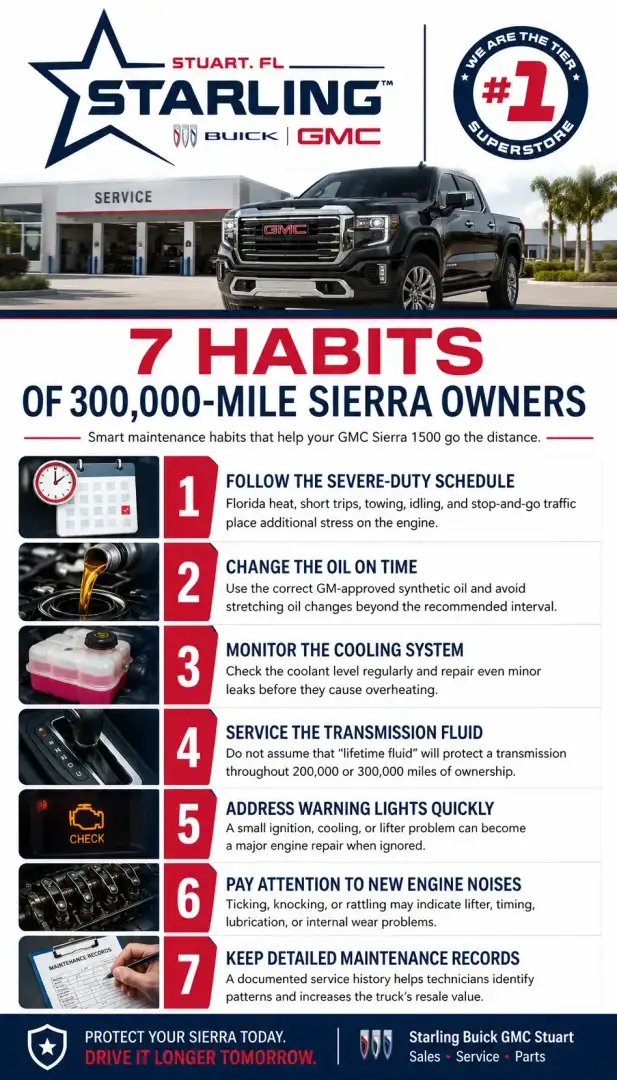
Follow the Severe-Duty Maintenance Schedule
GM’s Severe Duty maintenance schedule, which is buried in the back of every Sierra owner’s manual and almost never discussed at the point of sale, applies to any of these conditions: towing or hauling frequently, extensive idling, driving in dusty conditions, stop-and-go driving, temperatures consistently above 90 degrees, or trips under 4 miles. In Stuart, Florida, most Sierra owners qualify for the Severe Duty schedule on at least two or three of those criteria. The Sierra 1500 maintenance schedule for the 5.3L V8 under Severe Duty conditions calls for a 3,000 to 5,000 mile oil change interval, not the 7,500-mile interval that the Oil Life Monitor sometimes displays. Using the Severe Duty schedule in Florida’s climate is not being overcautious. It is correctly calibrating maintenance to the actual operating environment.
Change the Transmission Fluid Even If GMC Says ‘Lifetime’
The GM 10-speed automatic transmission used in the Sierra 1500 is factory-filled with DEXRON-HP fluid and labeled ‘lifetime fill’, meaning GM does not specify a replacement interval under normal use. Many transmission specialists and long-term Sierra owners treat this designation with appropriate skepticism. Transmission fluid degrades from heat cycling, friction material breakdown, and contamination over time, and a transmission that is running on 150,000-mile fluid is not a transmission receiving full protection from its lubricant. The consensus among Sierra-focused independent mechanics and service managers: change the transmission fluid at 60,000 to 80,000 miles regardless of the ‘lifetime’ designation, and again at 120,000 to 150,000 miles for trucks used for regular towing or high-mileage highway driving. The cost of a transmission fluid change at our service department, approximately $150 to $200, is a fraction of the cost of a transmission repair that fluid degradation can accelerate. We do not categorically recommend ignoring any manufacturer specification. We do recommend understanding why the ‘lifetime’ designation was chosen, primarily for warranty period purposes, and making an informed decision about whether it serves your long-term ownership goals.
Address Warning Lights the Same Week They Appear
The Check Engine light, an oil pressure warning, a transmission temperature alert, or any engine-related warning message on a Sierra 1500 should be treated as a same-week service priority, not a same-month priority, and definitely not a ‘when it gets worse’ priority. The GM engine management system is not in the habit of generating warning lights for trivial reasons. When a check engine light appears with a misfire code on a 5.3L Sierra, it is either an ignition component failure (spark plug or coil, a $30 to $100 repair) or an AFM/DFM lifter beginning to fail (a $1,200 to $8,000 repair depending on how quickly it’s addressed). The difference in repair cost between diagnosing the same week versus diagnosing after another 5,000 miles can be measured in thousands of dollars. Our service department at Starling Buick GMC Stuart reads fault codes as part of any diagnostic visit, bring your Sierra in when the light appears, not when the problem becomes undeniable.
Signs Your Sierra 1500 Engine Is Nearing the End
Most Sierra 1500 engines do not fail suddenly and without warning. They communicate for weeks or months before a terminal failure event through specific, identifiable symptoms that a knowledgeable owner can recognize. The three symptoms below are the most reliable indicators that an engine is entering the final stages of its service life, the signs that indicate either a significant repair is coming or that the repair-versus-replace-versus-trade calculation is approaching.
None of these symptoms means the engine is done today. They mean the engine has entered a condition where the trajectory is predictable and the decision about how to respond should be made now, not when the truck stops starting.
Blue or White Smoke from the Exhaust
Blue smoke from the exhaust indicates oil burning, engine oil is entering the combustion chamber and burning with the fuel. This can result from worn piston rings, worn valve stem seals, or in the context of 5.3L AFM engines specifically, from the increased oil consumption that cylinder deactivation systems can cause in aging engines. White smoke at normal operating temperature (not the white water vapor visible on cold mornings) indicates coolant entering the combustion chamber, a head gasket failure. Both blue and white smoke are serious symptoms that do not resolve on their own. Blue smoke from oil burning can progress slowly over tens of thousands of miles; white smoke from coolant intrusion can indicate active cooling system failure that will accelerate into complete engine damage quickly. Either smoke color warrants a service appointment the same week it’s observed, not the same month, and not after the next road trip.
Metal in the Oil at Change Intervals
At every oil change, the used oil should be examined visually on the drain plug magnetic tip and in the used oil itself. A healthy drain shows clear, dark oil with minimal solid particles visible. An engine with abnormal internal wear shows metallic glitter, fine silver or gold particles suspended in the oil or visible on the drain plug magnet, or in severe cases, visible metallic sludge in the oil. Metal particles in oil indicate that engine surfaces are wearing at a rate beyond normal and that those wear particles are circulating through the engine with each oil cycle, accelerating damage on every surface they contact. A drain plug magnet with significant metallic deposits at a normal oil change interval on a Sierra 1500 warrants an immediate diagnostic conversation about the source, not a routine comment and a new filter.
Persistent Loss of Power or Rough Idle
A Sierra 1500 that has progressively lost power over several months, not the sudden power loss of a misfire, but a gradual reduction in the pulling and acceleration capability that the truck once had, is often exhibiting compression loss. As cylinder seals wear, combustion pressure escapes past the piston rings and into the crankcase rather than pushing the piston down. A compression test at a service center is inexpensive and diagnostic: any cylinder more than 10 percent below specification or significantly below adjacent cylinders indicates that the ring seal on that cylinder is compromised. A rough idle with no current misfire codes, particularly one that is most noticeable at cold start and smooths out after warm-up, can indicate worn timing chain components, particularly on higher-mileage 5.3L trucks where timing chain stretch becomes a factor above 150,000 miles. Neither compression loss nor timing chain wear is a same-day crisis. Both are conditions that define the trajectory and inform the rebuild-versus-replace calculation.
When to Rebuild vs. Replace vs. Trade the Truck
The rebuild-versus-replace-versus-trade decision is a financial calculation that depends on the truck’s current value, the cost of the required repair, the remaining service life after the repair, and the cost of the alternative. There is no universal right answer, the correct choice for a Sierra with 180,000 miles and a lifter failure is different from the correct choice for a Sierra with 95,000 miles and the same failure. For a full breakdown of ongoing ownership costs, see our GMC Sierra cost of ownership guide.
The general framework: rebuild or repair if the cost of the repair is less than 40 to 50 percent of the vehicle’s current market value AND the rest of the vehicle is in good condition AND you plan to keep the truck for at least two to three more years. A $3,500 lifter repair on a Sierra 1500 worth $28,000 in good overall condition is a clear repair decision. The same $3,500 repair on a Sierra worth $8,000 with 220,000 miles and multiple other deferred maintenance items is a different calculation. Trade or sell if the repair cost exceeds 50 to 60 percent of the vehicle’s market value, if there are multiple simultaneous failure indicators suggesting the engine is at its end of life rather than experiencing an isolated failure, or if the truck has significant rust or structural issues that make the repair investment unsound regardless of engine condition. Our service advisors at Starling Buick GMC Stuart can provide a pre-repair assessment that gives you an honest picture of the truck’s overall condition alongside the specific repair needed, so you are making the rebuild-or-trade decision with complete information rather than just the cost of the immediate repair.
Frequently Asked Questions
The questions below represent the most common engine longevity questions our service team and sales team receive about Sierra 1500 trucks, from both new buyers evaluating a Sierra purchase and existing owners managing high-mileage trucks.
How many miles is too many for a used Sierra 1500?
There is no universal ‘too many miles’ threshold for a Sierra 1500, the more useful question is: what maintenance history does this truck have? A Sierra with 180,000 documented miles and full service records from a single owner is a better buy than a Sierra with 90,000 mystery miles and no paperwork. At Starling Buick GMC Stuart, we offer Certified Pre-Owned Sierras with verified histories and comprehensive inspections that address this question directly. For private-market purchases of high-mileage Sierras, a pre-purchase inspection from our service department, which includes a compression test, oil analysis, AFM/DFM assessment on V8 models, and full fault code scan, is approximately $150 to $200 and is the most useful $150 you can spend on a used Sierra evaluation.
Which Sierra 1500 engine lasts the longest?
The 3.0L Duramax diesel has the strongest case for maximum long-term lifespan based on diesel engine fundamentals: lower RPM under load, higher torque at lower stress levels, and an architecture designed for sustained heavy use. Among the gasoline engines, the 6.2L V8 in well-maintained examples shows fewer AFM/DFM lifter failures per mile driven than the 5.3L, though the 6.2L carry the 2021-2024 recall caveat for the connecting rod issue. The 5.3L’s proven durability when the AFM/DFM system is monitored carefully is excellent, it is the most reliable GMC truck engine simply because it is the most common Sierra engine overall.
Is the 5.3L V8 more reliable than the 6.2L?
Over a broad population and long mileage range, the 5.3L’s AFM lifter failure rate is higher than the 6.2L’s in owner complaint data. However, the 6.2L carries the active NHTSA recall on 2021-2024 trucks that the 5.3L does not. The 5.3L has more long-term mileage data at 150,000-plus miles given that it’s been in production longer and in greater volume. Both engines are capable of 200,000-plus miles with appropriate maintenance. The 5.3L’s reliability is more established; the 6.2L’s recall situation on recent model years warrants specific attention.
Do Sierra 1500s have engine problems?
All high-volume engines have some documented failure modes, and the Sierra 1500 is no exception. The AFM/DFM lifter issue on the 5.3L V8 is real and documented, and the 6.2L’s active recall on 2021-2024 trucks is an ongoing concern. These are meaningful facts that a buyer should know. They are also not representative of the average Sierra 1500’s ownership experience, the majority of Sierra 1500 trucks are serviced through their entire lives without a major engine failure. The failure modes are specific enough to manage proactively: monitor the 5.3L for early AFM/DFM ticking, verify recall completion on a 6.2L-equipped 2021-2024 truck before purchase, and maintain oil changes on a Florida-appropriate interval for either engine. For a complete overview of the model, see our GMC Sierra truck buyer’s guide.
Is a Sierra 1500 with 200,000 miles worth buying?
It depends entirely on the maintenance history and current mechanical condition, which is why a pre-purchase inspection is non-negotiable at that mileage. A Sierra 1500 with 200,000 miles and documented service throughout its life is potentially many more years from a serious engine issue. A Sierra 1500 with 200,000 miles and unknown history is a variable that requires professional assessment before purchase. Our Certified Pre-Owned program at Starling Buick GMC Stuart vets vehicles specifically so that buyers do not face this uncertainty, but for private-market purchases, a professional inspection is the appropriate investment.
Get Your Sierra 1500 Engine Inspected at Starling Buick GMC Stuart
Whether you own a current-generation Sierra and want a proactive engine health assessment, are shopping for a used Sierra and want a pre-purchase evaluation, or are managing a high-mileage truck and trying to understand its trajectory, Starling Buick GMC Stuart’s service department is equipped to give you the honest picture. Our GM-certified technicians work exclusively on GMC and Buick vehicles and see Sierra engines at every mileage and condition level.
A comprehensive engine inspection at our service department at 2445 SE Federal Hwy in Stuart covers oil condition and analysis, compression testing, AFM/DFM system assessment for V8 trucks, full fault code scan, cooling system condition, and a recall check for open NHTSA campaigns affecting your specific VIN. Contact our service team to schedule your appointment.
Conclusion
A GMC Sierra 1500 engine that receives proper maintenance in Florida’s specific climate regularly reaches 200,000 to 300,000 miles on the original engine. The factors that determine whether your Sierra makes it there are within your control: oil change frequency and quality, cooling system attention, AFM/DFM monitoring on V8 trucks, recall verification, and addressing warning signs the same week they appear rather than deferring until the problem becomes expensive. The Duramax diesel has the strongest long-term lifespan case. The 5.3L V8 is the most proven high-mileage engine by volume. The 6.2L V8 is capable of full longevity with appropriate maintenance and verified recall completion. The TurboMax four-cylinder is on track for 200,000-plus miles based on its early owner data. None of these engines fail early without warning. They tell you what’s coming, consistently and in advance. The owners who listen are the ones with 300,000-mile trucks.
Visit Starling Buick GMC Stuart at 2445 SE Federal Hwy to schedule your Sierra 1500 engine inspection or pre-purchase evaluation.
0 comment(s) so far on How Long Does a GMC Sierra 1500 Engine Last?