






GMC Sierra EV Real-World Range in Florida Heat: What to Expect & How to Maximize It
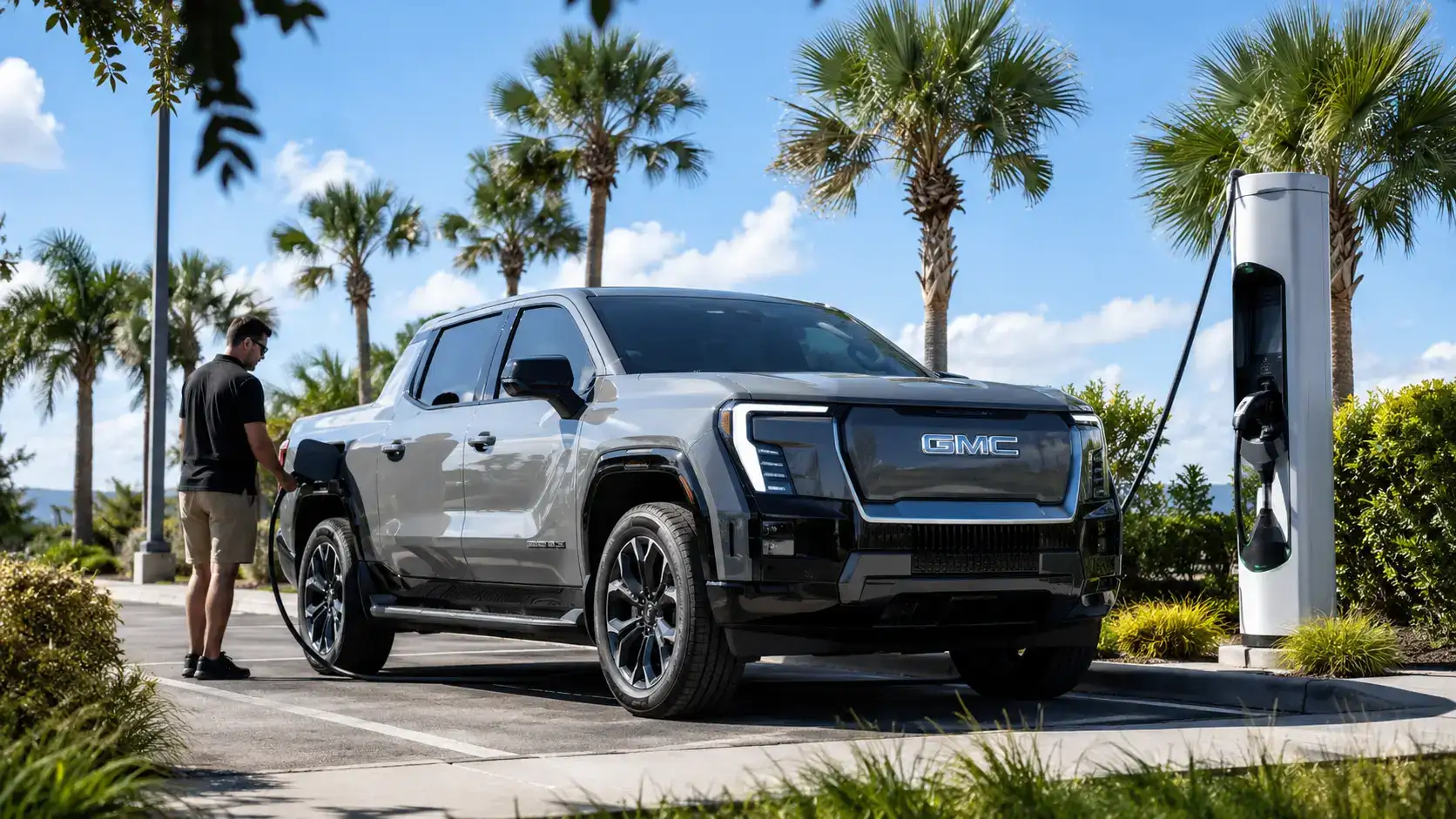
The GMC Sierra EV Denali is, by any objective measure, one of the most capable electric vehicles sold in the United States in 2026. Its Max Range battery delivers an EPA-estimated 478 miles on a single charge. Its 800-volt architecture enables DC fast charging at up to 300 kW, adding approximately 116 miles of range in 10 minutes. It tows up to 12,500 lbs with the extended-range battery. And it does all of this in a truck with 24-inch wheels, open-pore wood trim, standard Super Cruise, and a 14-inch head-up display.
What the EPA sticker does not tell you is what 478 miles means on a 92-degree August day in Stuart, Florida, driving south on I-95 with the AC on full, towing a 22-foot boat to the Hobe Sound ramp, or running errands across Martin County in stop-and-go afternoon traffic. The range experience that Florida buyers have in practice is different from what the EPA test produces, and understanding those differences before purchase is the foundation for realistic ownership expectations. This guide covers the specific range impacts of Florida’s heat, real-world route examples from Stuart, and the seven practices that most effectively protect range in South Florida conditions.
Quick Answer: How Much Range You Actually Lose in Florida Summer
The Sierra EV Denali does not lose catastrophic range in Florida heat, it is not an EV that becomes unusable in warm climates. But the range impact of Florida’s conditions is real, measurable, and worth understanding before planning a trip or evaluating whether the vehicle’s range suffices for your specific use.
The most important distinction is between ‘hot weather’ range loss, which is modest, and ‘extreme heat combined with heavy thermal management load’, which is more significant. A Sierra EV Denali on a warm but not brutally hot Florida day, with pre-conditioning completed before departure, will deliver range close to its EPA estimate. The same vehicle in a full Florida summer afternoon without pre-conditioning will deliver meaningfully less.
4–5% Loss Under 90°F vs. Up to 15–20% Loss Above 95°F
Industry EV range data across multiple platforms consistently shows that temperatures in the 80 to 90 degree Fahrenheit range produce approximately 4 to 5 percent range reduction from EPA estimates. At those temperatures, the battery thermal management system maintains the battery in its optimal operating range without significant energy overhead. At temperatures above 95 degrees Fahrenheit, the daily summer reality in Stuart from June through September, the range impact increases to approximately 15 to 20 percent as the battery thermal management system works harder and the cooling system draws more power to maintain safe battery temperatures.
Applied to the Sierra EV Denali’s 478-mile Max Range estimate: under 90-degree conditions, expect approximately 455 to 460 miles of practical range. In full Stuart summer above 95 degrees without pre-conditioning, expect approximately 380 to 405 miles. These figures represent real-world starting points that vary further based on driving speed, AC use, terrain, and the specific age and condition of the battery. Edmunds conducted real-world range testing of the extended-range Denali and measured 507 miles on a single charge in a mixed driving test, 97 miles beyond its EPA estimate, confirming that the Sierra EV’s real-world range frequently meets or exceeds its EPA figure in optimal conditions.
AC Use Is Far Less Costly Than Most Buyers Think
One of the most common EV misconceptions, particularly among buyers accustomed to managing fuel cost, is that running the AC aggressively in a hot climate will substantially reduce range. The reality is more nuanced: cabin AC in the Sierra EV typically consumes 1 to 3 kWh per hour of operation in Florida summer conditions, representing approximately 0.2 to 0.6 percent of the Max Range battery’s 205 kWh capacity per hour of driving. A two-hour highway drive with the AC running on full in 95-degree heat costs approximately 2 to 6 miles of range reduction compared to driving with no AC. This is not nothing, but it is also not the dramatic range penalty that many buyers anticipate. Drive with the AC on fully in Florida, the range cost of being uncomfortable in the cabin is not worth the modest range savings.
Why Heat Affects EV Range Differently Than Cold
Cold weather is harder on EV range than heat, this is counterintuitive to many Florida buyers who are accustomed to thinking of heat as the primary environmental stressor. Understanding why cold is more damaging than heat explains why the Sierra EV is actually well-suited to Florida’s climate compared to EV performance in northern states.
The fundamental physics: lithium-ion battery chemistry becomes less efficient at low temperatures because the ionic movement within the battery slows, increasing internal resistance and reducing the energy available for the motors. In sub-freezing temperatures, EVs routinely experience 20 to 40 percent range reduction while simultaneously running a cabin heating system that draws substantial battery power, a double penalty that Florida drivers will never experience. Florida’s heat creates a single, manageable challenge: keeping the battery cool enough to operate efficiently, which the Sierra EV’s active thermal management handles without the dramatic efficiency penalty of cold-weather operation.
Battery Thermal Management Working Harder, Not Heating the Cabin
In Florida heat, the Sierra EV’s battery thermal management system uses coolant loops to maintain battery temperature in the optimal operating range, typically 60 to 90 degrees Fahrenheit. When ambient temperature is 95 degrees and solar radiation is heating the battery pack, the cooling system runs more aggressively, consuming additional electrical energy to maintain that target temperature range. This is where the modest Florida heat range penalty comes from, not from the cabin AC, but from the battery cooling system’s increased load. Pre-conditioning the vehicle while plugged in, addressed in the range maximization section, allows the thermal management system to pre-cool the battery to its optimal temperature using grid power before departure, starting the drive with a battery already in its efficient operating range rather than one that needs to be cooled down in transit.
Why Florida Summers Are Actually Easier on Range Than Northern Winters
A Sierra EV Denali operated in Minnesota in January will experience approximately 25 to 40 percent range reduction on days where temperatures reach minus-10 to minus-20 degrees Fahrenheit, while simultaneously running a heat pump or resistive heater that consumes substantial battery power to warm the cabin and battery pack. The same vehicle in Stuart in July experiences approximately 10 to 15 percent range reduction in peak heat conditions while running an AC system that costs modest range per hour. Florida EV ownership is meaningfully more range-efficient on a year-round basis than northern-state EV ownership, and Stuart’s climate, despite its intense summer heat, produces less total annual range impact than any northern climate would. The Sierra EV buyer in Stuart is making a different ownership calculation than the Sierra EV buyer in Chicago, and the Florida calculus is more favorable.
Real-World Range Examples for the Sierra EV Denali
The three route examples below use the Sierra EV Denali with Max Range battery (478 miles EPA) as the baseline vehicle. Range estimates account for Florida summer conditions including AC use, traffic patterns, and the road characteristics of each route. These are planning estimates for typical conditions, actual range will vary based on specific driving behavior, payload, AC intensity, and day-to-day temperature variation.
All three examples assume the vehicle departs with a full charge and the cabin pre-conditioned while plugged in.
Stuart to Miami Round-Trip (Highway, 85°F+, AC On)
Stuart to Miami one-way is approximately 105 miles via I-95 southbound. Round trip: approximately 210 miles. At 65 to 70 MPH with AC on in 85-degree conditions, the Sierra EV Denali Max Range will consume approximately 250 to 270 miles of range equivalently, accounting for driving efficiency, AC load, and the typical I-95 traffic pattern through Palm Beach County and Broward. A full 478-mile charge comfortably completes the round trip with substantial reserve and no charging required en route. At hotter temperatures above 95 degrees, and at faster speeds consistently above 70 MPH, range consumption increases, still completing the round trip comfortably from a full charge, but with less reserve. For buyers who make this run regularly, the Sierra EV Denali Max Range eliminates the charging consideration entirely on this route.
Stuart to Orlando (Mixed Highway and City)
Stuart to Orlando via Florida’s Turnpike is approximately 135 miles one-way, the most common long-distance run for Treasure Coast residents. One-way in summer conditions at highway speed with AC on: approximately 160 to 180 miles of range consumed, accounting for the turnpike’s sustained 70 MPH pace and Florida summer heat. One-way is well within the Max Range battery’s capacity from a full charge. A round trip of approximately 270 miles in warm-weather conditions consumes approximately 320 to 360 miles of range, still completable on a single charge from the Max Range battery, with 120 to 160 miles of reserve remaining on arrival back in Stuart. Buyers who make this round trip regularly and charge at home overnight will find it routine. For the extended-range (410 miles EPA) configuration, the same round trip still completes on a single charge with reserve.
Daily Commuting in Treasure Coast Heat
The Stuart area’s typical daily commute pattern, 15 to 40 miles round trip, a mix of US-1, Federal Highway, and I-95 segments, requires approximately 18 to 50 miles of range per day in summer conditions. At this consumption rate, the Max Range battery supports 9 to 26 days of daily commuting between charges. No Treasure Coast commuter will come close to exhausting the Sierra EV’s range on a daily driving basis. The practical charging pattern for most Stuart owners is weekly or semi-weekly home charging to a consistent 80 percent charge level, a practice that supports long-term battery health while maintaining more than sufficient range for any reasonable local driving pattern. The Sierra EV’s ability to provide 40 miles of range in roughly 10 minutes on a DC fast charger at Supercharger stations along US-1 and Federal Highway means that even a commuter who misses a charging night has a straightforward recovery option.
How Towing Compounds the Hot-Weather Range Hit
Towing is the variable that most significantly changes the Sierra EV’s real-world range calculation. Unlike the modest range cost of cabin AC, 1 to 3 kWh per hour, towing a heavy trailer at highway speed can consume 2 to 3 times the energy per mile as unloaded highway driving. The combination of Florida summer heat, sustained highway speed, and a heavy trailer load is the most demanding operating condition for Sierra EV range, and it requires specific pre-trip planning to avoid range anxiety on longer towing routes.
Towing a Boat to the Marina: Range Math Owners Need to See
A 22-foot center console boat and trailer at 6,500 lbs towed at 60 MPH on I-95 in 90-degree heat draws approximately 90 to 110 kWh per 100 miles of operation on the Sierra EV, approximately 2.5 times the energy consumption of unloaded highway driving. At 100 kWh per 100 miles average consumption, the Max Range battery’s 205 kWh capacity produces approximately 205 miles of towing range in these conditions. For Stuart boaters whose boat ramp access is within 50 miles each way, including Hobe Sound, Port Salerno, Lake Okeechobee access points, and the St. Lucie Inlet, the Sierra EV handles the towing round trip on a single charge from full with comfortable reserve. For longer towing trips, trailering to the Keys, to Boca Grande, or to a remote fishing access point 80 to 100 miles away, building in a 20 to 30 minute DC fast charge stop at the destination or at a mid-route charging station produces a manageable and predictable trip. The Sierra EV Denali’s 300 kW DC fast charge capability adds approximately 116 miles of range in 10 minutes at a compatible charger, a meaningful amount of range recovery in a short stop.
7 Ways to Maximize Sierra EV Range in Florida
The seven practices below are ordered by typical impact. The first three, pre-conditioning, departure temperature setting, and speed management, have the largest individual effects on range in Florida conditions. The remaining four are meaningful contributors that accumulate over regular ownership.
Pre-Cool the Cabin While Still Plugged In
This is the highest-impact range management action available to Florida EV owners and the one that most differentiates experienced EV drivers from new ones. Pre-conditioning the Sierra EV’s cabin, cooling it to target temperature while the vehicle is still connected to the charger, accomplishes two things simultaneously: it uses grid power rather than battery power to bring the cabin to temperature, and it pre-cools the battery pack to its optimal operating range before the drive begins. A cabin pre-conditioned to 70 degrees using grid power before a 95-degree Florida afternoon departure will maintain that temperature with far less battery energy during the first 30 minutes of driving than a cabin that starts at 150 degrees and requires the AC to drop it 80 degrees using only battery power. For a Stuart owner whose daily departure is in the afternoon heat, cabin pre-conditioning is the single most effective range-protection habit available.
Use the App to Set Departure Temperature
The myGMC app allows Sierra EV owners to schedule departure time and target cabin temperature for pre-conditioning while plugged in. Set the departure time to coincide with your regular morning or afternoon departure, set the target temperature to your preferred cabin temperature, and the Sierra EV will automatically begin the pre-conditioning process so that the cabin and battery are at target temperature at departure time using grid power. This is not a convenience feature, in Florida’s climate, it is a range management tool that meaningfully reduces the peak thermal load the battery carries through the first portion of every drive.
Slow Down on I-95 (Speed Hurts Range More Than Heat)
The relationship between speed and range is not linear, it is exponential. Aerodynamic drag increases with the square of speed, meaning that driving at 75 MPH instead of 65 MPH does not increase range consumption by 15 percent; it increases it by approximately 32 percent. On I-95 from Stuart to Fort Lauderdale at 65 MPH, the Sierra EV Denali Max Range might consume approximately 120 miles of range. At 75 MPH on the same route in the same conditions, it consumes approximately 158 miles. For a buyer evaluating whether the extended-range or Max Range battery is necessary for a specific regular route, reducing highway speed from 75 to 65 MPH is often a more effective solution than purchasing the larger battery. This is not practical for every driver or every commute, but for Stuart buyers who have the flexibility to drive at 65 MPH and are managing range on a specific route, the speed reduction is the most powerful single lever available.
Park in the Shade or Use a Sunshade
A Sierra EV parked in direct Stuart sun reaches interior temperatures of 150 to 175 degrees Fahrenheit. The battery pack, insulated from the cabin but still subject to radiant heat, reaches elevated temperatures that cause the thermal management system to run pre-emptively, drawing battery power even while parked, to prevent battery damage. A vehicle parked in shade with a reflective windshield sunshade reaches significantly lower peak interior temperatures, reducing the thermal management load and the battery drain that occurs during extended outdoor parking. For a Stuart owner who parks outside during a workday, the shaded parking decision and the windshield sunshade combine to preserve perhaps 3 to 5 miles of additional range per day compared to unshielded sun exposure, a modest but real accumulation over the ownership period.
Charge Between 20% and 80% in Hot Weather
Lithium-ion battery longevity is maximized when the battery is operated in the middle of its state-of-charge range and minimized when the battery is repeatedly charged to 100 percent and discharged to near 0 percent. In Florida’s heat, which already stresses battery chemistry more than cool climates, the standard recommendation of charging to 80 percent for daily use is especially appropriate. The Sierra EV’s charge settings allow the owner to set a maximum charge limit, set to 80 percent for daily use, manually overriding to 100 percent when a long trip requires maximum range. Charging to 100 percent in Florida heat, leaving the vehicle outdoors in the sun, and then departing six hours later is the highest-stress scenario for battery chemistry over the ownership period. 80 percent daily charging, plugged in at home or at a destination where the thermal management can use grid power to maintain battery temperature, is the best long-term battery health practice.
Use Eco Mode for Daily Driving
The Sierra EV’s Eco drive mode reduces maximum acceleration output and optimizes energy regeneration to extend range in daily driving conditions. On Stuart’s lower-speed driving environments, US-1, Federal Highway, neighborhood roads, Eco mode’s regenerative braking aggressiveness is particularly useful, recovering energy on every deceleration that would otherwise be lost as heat in conventional braking. The range benefit of Eco mode on daily urban driving is approximately 5 to 10 percent above the equivalent driving in Normal mode, based on typical urban driving profiles. For highway driving at constant speed, Eco mode provides less additional benefit since there are fewer acceleration and deceleration events to optimize.
Keep Tires at Proper Pressure (Hot Roads = Higher PSI)
Underinflated tires increase rolling resistance, the energy required to move the tire along the road surface, which directly increases energy consumption and reduces range. Florida’s hot road surfaces, which can reach 140 to 160 degrees Fahrenheit in direct summer sun, cause tire pressure to increase above the cold-inflation specification. The Sierra EV’s tire pressure monitoring system displays current tire pressure, but it is worth knowing that tires on a vehicle parked in the Florida sun for several hours will show higher pressure readings than the same tires checked cold in the morning. Check tire pressure cold, first thing in the morning before the vehicle has been driven, and inflate to the specification on the door jamb sticker. Properly inflated tires on the Sierra EV’s larger wheel and tire packages represent a small but real range improvement over the underinflated alternative.
Charging in Florida Heat: What Owners Should Know
The Sierra EV’s 800-volt architecture and 300 kW DC fast charging capability make it one of the fastest-charging trucks available, but Florida’s heat introduces specific considerations for charging behavior that owners should understand to avoid range and battery management surprises.
Why DC Fast Charging Can Slow Down When the Battery Is Hot
DC fast charging generates heat in the battery as a byproduct of the rapid energy transfer, this is unavoidable physics. When the battery arrives at a fast charger already at elevated temperature from a Florida summer drive, the charging management system may reduce the charging rate to prevent the battery from reaching temperatures that could damage cells. This ‘thermal throttling’ of charging rate is not a malfunction, it is the thermal management system protecting the battery. The practical experience: if you arrive at a DC fast charger after a sustained highway drive in full Florida summer heat and find that the initial charging rate is below the expected 300 kW, allow 10 to 15 minutes for the thermal management system to cool the battery, at which point charging rate typically returns to near maximum. Pre-conditioning the vehicle before departure, including pre-cooling the battery, reduces the likelihood of arriving at a charger with an already-warm battery.
Best Times of Day to Charge at Home
Home charging with a Level 2 charger, the standard installation for Sierra EV home charging, is the overnight charging scenario that most Stuart owners will use as their primary charging method. The optimal charging time in Florida is overnight after midnight, when ambient temperatures are at their lowest, electricity rates are lowest (if your utility offers time-of-use pricing), and the battery is not being stressed by solar radiation during charging. Setting the Sierra EV’s scheduled departure time allows the charging process to complete close to departure, ending the charge at 5 or 6 AM rather than at midnight, which means the battery is at its target charge level and temperature at departure rather than having been at full charge for six hours in the pre-dawn heat.
Long-Term Battery Health in Florida Climate
The long-term battery health question is the one most frequently raised by Stuart buyers evaluating an EV purchase: will Florida’s heat degrade the battery faster than cooler-climate operation? The honest answer: heat does incrementally accelerate battery degradation relative to cooler climates, but the margin is smaller than many buyers expect, and GMC’s battery warranty provides meaningful protection regardless.
Should You Park Indoors? Realistic Answer
If you have a garage, and most Stuart residential properties do, parking the Sierra EV indoors is worth doing when practical. A garage-parked EV avoids the peak solar radiation exposure that drives battery heating during parking, reduces the thermal management system’s workload, and allows the vehicle to start each day from a lower-temperature baseline. The range benefit of garage parking over repeated outdoor summer days accumulates into meaningful battery life and daily range preservation over the ownership period. For Stuart buyers who do not have garage access, downtown condos, marina parking, and some residential properties, the vehicle’s thermal management system handles outdoor Florida conditions without catastrophic battery health impact. The practices described in this guide, pre-conditioning, avoiding 100 percent charges in heat, maintaining consistent charging routines, compensate substantially for the absence of garage parking.
What GM’s Battery Warranty Covers
GM provides an 8-year / 100,000-mile battery and drive unit warranty on the Sierra EV. This warranty covers defects in materials and workmanship and guarantees that the battery will retain a minimum state of health, defined as maintaining at least 70 percent of its original capacity, within the warranty period. For a Sierra EV Denali Max Range buyer in Stuart, this means that if the battery’s capacity falls below approximately 335 miles EPA equivalent within 8 years or 100,000 miles, GM is obligated to repair or replace the battery. This is not unlimited coverage against all battery degradation, batteries naturally lose a small amount of capacity over years of cycling, but it is a meaningful floor that protects against the accelerated degradation that Florida’s climate might theoretically produce. The warranty reflects GM’s confidence in the battery system’s durability across a range of climates including Florida.
Conclusion
The GMC Sierra EV Denali is a capable and practical vehicle for Stuart and Treasure Coast buyers whose driving patterns fall within its realistic range envelope. The Max Range battery’s 478-mile EPA estimate reduces to approximately 380 to 460 miles under typical Florida conditions depending on temperature and driving style, range that covers the vast majority of Treasure Coast driving scenarios without range anxiety. The seven practices described in this guide, particularly pre-conditioning, speed management, and daily charging to 80 percent, represent the difference between an ownership experience that falls short of the EPA promise and one that consistently meets or exceeds practical range expectations.
At Starling Buick GMC Stuart, we carry the Sierra EV lineup and can arrange extended test drives that include highway driving in Florida conditions, the most useful evaluation for a buyer whose range concerns are specifically about real-world performance rather than EPA numbers.
0 comment(s) so far on GMC Sierra EV Real-World Range in Florida Heat: What to Expect & How to Maximize It