






How to Safely Tow a Boat, RV, or Trailer with Your GMC Sierra (Florida Driver’s Guide)
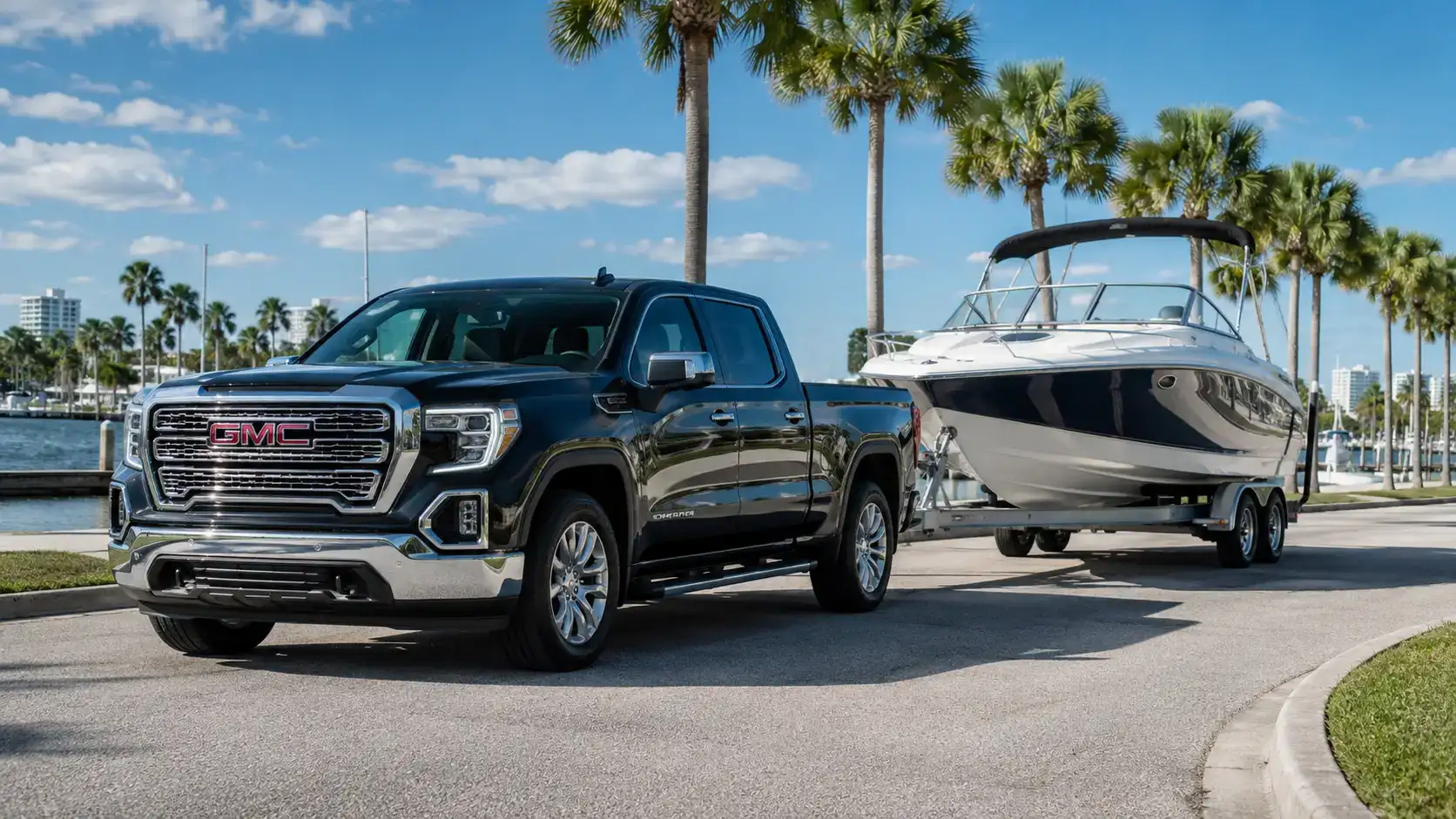
The Treasure Coast is towing country. The St. Lucie River, the Indian River Lagoon, Lake Okeechobee, and the Atlantic coast put boats, personal watercraft, and fishing trailers on Stuart’s roads year-round. The weekend run to Jonathan Dickinson State Park with a camper, the haul to Everglades City with a duck boat, the commercial contractor pulling equipment from Stuart to West Palm Beach, the GMC Sierra is the platform that handles all of it. And yet towing is the single vehicle operation that produces the most preventable accidents, mechanical failures, and expensive repairs among drivers who do it only occasionally.
This guide is written for GMC Sierra owners on the Treasure Coast who tow seriously, whether that means a 22-foot center console twice a week or a travel trailer twice a year. The information here is specific, specific tow ratings by engine for the 2026 Sierra, specific Stuart-area considerations including the boat ramps and I-95 crosswind situations that local drivers encounter, and specific guidance on the Sierra’s built-in trailering technology. If you know your truck well and tow regularly, some of this will be familiar. If you are newer to towing or upgrading to a Sierra from a crossover or smaller vehicle, this guide starts from the right foundation.
Before You Hook Up: Know Your Sierra’s Real Tow Rating
The Sierra’s published maximum towing capacity, 13,300 lbs with the Duramax diesel in the right configuration, is a meaningful number that tells you what the truck can do at its absolute limit in a specific, rarely-achieved configuration. It is not the number you use when you back your specific truck down a boat ramp with your specific trailer. That number is on your truck’s door jamb sticker, and it accounts for every variable that the maximum rating does not: your specific cab configuration, your specific engine, your specific drivetrain, and whether the Max Trailering Package (RPO code NHT) is installed on your truck. The door jamb sticker is the authoritative towing capacity for your Sierra. Start there.
Beyond the sticker, towing capacity is the theoretical maximum for the trailer and its contents. The practical towing decision is more nuanced, because the trailer is not your only load. The passengers in your cab, the gear in your bed, the tongue weight on your hitch, all of it counts against your truck’s available capacity in ways that the headline towing number does not make obvious. The three numbers described in this section, GVWR, GCWR, and payload, are the framework that lets you understand your actual towing situation rather than just the advertised one.
Tow Rating by Engine (2.7L Turbo, 5.3L V8, 6.2L V8, 3.0L Duramax)
All figures below are from GMC’s confirmed 2026 Sierra 1500 specifications and represent maximum ratings in properly equipped configurations. Your specific truck’s door jamb sticker is the authoritative number for your vehicle. Configuration variables, cab style, bed length, 2WD versus 4WD, and package equipment, affect where within these ranges your specific Sierra falls.
|
Engine |
HP / Torque | Max Towing (properly equipped) | Best Use Case |
| 2.7L TurboMax I4 | 310 HP / 430 lb-ft | Up to 9,400 lbs |
Daily driving + light to moderate trailer/boat towing |
|
5.3L EcoTec3 V8 |
355 HP / 383 lb-ft | Up to 11,200 lbs | Versatile, covers most Treasure Coast recreational towing |
| 6.2L EcoTec3 V8 | 420 HP / 460 lb-ft | Up to 13,100 lbs |
Heavy trailers, large boats, confident margin near maximum |
|
3.0L Duramax Turbo-Diesel |
305 HP / 495 lb-ft | Up to 13,300 lbs |
Maximum towing + best fuel economy under load |
The 6.2L V8 reaching 13,100 lbs and the Duramax diesel reaching 13,300 lbs in their optimal configurations are both near the Sierra’s capability ceiling. The 200 lb difference is not operationally meaningful for the vast majority of towing scenarios. What is meaningful: the Duramax’s 495 lb-ft of torque available at low RPM versus the 6.2L’s 460 lb-ft, the diesel engine’s torque advantage at low RPM translates into less engine stress and better fuel economy during sustained towing at highway speed.
Why Max Tow Rating Isn’t the Number You Actually Plan Around
The maximum tow rating assumes specific conditions that rarely all align at once: the lightest available cab configuration, a 2WD drivetrain in most cases, no passengers or additional gear in the vehicle, and the Max Trailering Package installed. A Crew Cab 4WD Sierra with three adults, camping gear in the bed, and a trailer tongue load is a meaningfully different vehicle from the Double Cab 2WD bare truck that achieves the maximum rating. This is not a criticism of how GMC publishes its ratings, it is how all manufacturers publish ratings, and it is accurate. The practical planning number is the door jamb sticker minus the weight of your passengers and bed load, evaluated against the GCWR that defines the total permissible combination weight of the truck and trailer together.
The Three Numbers Every Sierra Tower Must Know
Understanding GVWR, GCWR, and payload is the difference between safe towing and towing that looks safe from the outside while operating the truck beyond its engineering limits. None of these numbers requires memorizing, they are all on labels in your vehicle or on GMC’s published specification sheets. But understanding what each one means and how they interact is essential before you hitch anything to your Sierra.
The most common towing mistake made by otherwise knowledgeable drivers is planning around the towing capacity alone without accounting for payload. A Sierra that can tow 11,200 lbs with the 5.3L V8 might have a payload rating of 1,700 lbs on a specific Crew Cab 4WD configuration. Loading two adults, gear in the bed, and a trailer with 500 lbs of tongue weight consumes most of that payload before anything goes wrong, but operating near or at payload limit while towing is the condition that produces trailer sway and braking problems.
GVWR, GCWR, and Payload Explained Simply
GVWR (Gross Vehicle Weight Rating) is the maximum permissible weight of the fully loaded truck, truck plus passengers plus cargo plus tongue weight of the trailer on the hitch ball. It is determined by the frame, suspension, axles, and braking capacity. Exceeding it is illegal and dangerous. GCWR (Gross Combined Weight Rating) is the maximum permissible weight of the truck and trailer together. It is determined by the drivetrain and braking system’s capacity to manage the combined load. Payload is GVWR minus curb weight, the actual weight-carrying capacity available for passengers, cargo, and tongue weight once the truck’s own weight is accounted for. Your specific Sierra’s payload is on the door jamb sticker, and it varies meaningfully between configurations. A Regular Cab 2WD Sierra will have a notably higher payload than a Crew Cab 4WD Sierra with identical engines because the additional cab structure, 4WD transfer case, and front axle hardware add curb weight that reduces the available payload budget.
Tongue Weight: The 10–15% Rule
Tongue weight is the downward force the trailer exerts on the hitch ball when the trailer is attached and the trailer’s load is properly distributed. For most trailers towed at highway speed, tongue weight should be 10 to 15 percent of the total trailer weight, enough forward load to keep the trailer tracking behind the truck rather than fishtailing, but not so much that it overloads the hitch and depresses the truck’s rear suspension excessively. A 6,000 lb boat and trailer should have 600 to 900 lbs of tongue weight when loaded correctly. That 600 to 900 lbs counts against your Sierra’s payload rating along with every pound of passengers and cargo in the truck. This is the calculation that many drivers skip, and it is the calculation that most directly explains trailer sway incidents on I-95 and Florida’s highways.
Choosing the Right Hitch for What You’re Towing
The hitch receiver is the common element in every Sierra towing setup, but the hitch hardware attached to it varies significantly based on what you are towing and how much it weighs. Using the wrong hitch type for a specific trailer is not just a compatibility issue, in the case of boat trailers with surge brakes, it is a safety issue that is specifically relevant to Treasure Coast towing scenarios.
Every current Sierra 1500 uses a Class III or Class IV receiver hitch with a 2-inch receiver opening. The hitch ball, ball mount, weight capacity, and additional equipment depend on what you attach.
Boat Trailers, Why You Cannot Use a Weight-Distribution Hitch with Surge Brakes
Surge brakes are the most common trailer braking system on boat trailers in Florida, and they operate on a mechanism that must be understood before any hitch hardware decisions are made. A surge brake coupler uses the compression force of the trailer pushing against the tow vehicle during deceleration, the surge, to hydraulically actuate the trailer’s wheel brakes. A weight-distribution hitch uses tension springs at the hitch head to distribute weight off the truck’s rear axle and onto all four wheels, improving stability and level ride. The problem is fundamental: a weight-distribution hitch keeps the coupler in constant tension during normal driving, which the surge brake coupler interprets as constant deceleration and applies the brakes continuously. Continuous brake engagement generates heat, wears brake pads, and can in extreme cases lead to brake lockup. Boat trailers with surge brakes must be towed with a standard ball mount, no weight distribution. Understand your trailer’s brake system before selecting hitch hardware.
Travel Trailers and RVs, When Weight Distribution Becomes Required
For travel trailers and RVs with electric trailer brakes, the common brake system on camping trailers, weight-distribution hitches are typically required by the trailer manufacturer and strongly recommended by GMC when tongue weight exceeds 750 lbs. Most towable RVs and travel trailers in the 5,000 to 10,000 lb range have tongue weights in the 750 to 1,500 lb range that will cause noticeable rear sag on the Sierra without weight distribution. Weight-distribution systems redirect that downward force through spring bars to the truck’s front axle, leveling the combination and restoring full braking effectiveness on the front wheels. For travel trailer and RV towing above 5,000 lbs on a Sierra, a weight-distribution hitch with sway control is not optional, it is the foundation of a safe, stable towing combination on Florida’s highways.
Utility & Car Trailers
Open utility trailers, enclosed cargo trailers, and car hauler trailers typically use standard ball-and-coupler connections without surge brakes. For loads up to 6,000 lbs, a standard Class III 2-inch ball mount with the appropriate ball diameter (typically 1-7/8 or 2 inches depending on the trailer coupler) is the correct setup. Trailers over 6,000 lbs with electric brakes require a brake controller in the tow vehicle, the Sierra with the ProGrade Trailering System includes an integrated trailer brake controller on SLT and above. Trailers over 8,000 lbs on a properly equipped Sierra may benefit from the weight-distribution approach depending on tongue weight and the truck’s rear sag with load.
How to Load a Trailer Correctly (60/40 Rule)
The 60/40 loading rule is the most practical guidance available for preventing the most common towing incident: trailer sway. Trailer sway initiates when the trailer’s weight distribution places too much mass behind the trailer’s axle, creating a pendulum effect that amplifies with speed and crosswind. Once sway initiates at highway speed, it can be very difficult to correct, the most common instinct, braking, can make it worse. Correct loading prevents sway initiation entirely.
The rule: 60 percent of the trailer’s load weight should be forward of the trailer’s axle centerline, and 40 percent behind it. This forward bias creates the tongue weight that holds the trailer’s nose down on the hitch ball and prevents the rearward pivot that initiates sway. It sounds simple and is often not followed in practice, especially with boat trailers where equipment tends to accumulate at the stern for convenience rather than for weight distribution.
Heavy Items Low, Forward, and Centered Over the Axle
Heavy items, coolers, anchors, batteries, motor fuel, gear boxes, should be loaded as low as possible in the trailer to keep the center of gravity down, as far forward of the axle centerline as the 60/40 rule directs, and centered laterally to avoid side-to-side imbalance that can contribute to sway on banked curves. For enclosed trailers, resist the instinct to load from the rear opening forward, which naturally puts the heaviest items rearward. Load from the front of the trailer to the back, placing heaviest items in the first 60 percent of the trailer’s length. For open utility trailers with irregular cargo, mentally divide the trailer at the axle centerline and evaluate whether more than 40 percent of the heavy items are behind that line.
Securing the Load for Florida Highway Speeds
Florida law requires that all trailer loads be secured to prevent shifting and to prevent material from falling onto the roadway. The practical towing standard is more rigorous than the legal minimum: loads should be secured so that no shifting occurs under emergency braking and during the lane-change maneuvers that are routine on I-95. Ratchet straps rated to at least 50 percent of the load weight, chain binders for heavy equipment, and cargo nets for loose items are appropriate tools. A load that shifts during a sudden braking event from 70 mph changes the trailer’s weight distribution dynamically, potentially moving weight rearward in the moment when forward bias is most needed. What holds in normal driving and what holds under emergency conditions are two different standards.
Pre-Trip Towing Checklist for Sierra Owners
The list below is not comprehensive for all towing scenarios, but it covers the items that most directly prevent the incidents we see among Stuart-area Sierra owners who tow regularly. The five minutes this checklist takes before any towing trip is the five minutes that prevents the roadside call, the bent trailer frame, or the missed appointment.
Tires, Lights, and Brake Controller
Trailer tires: check pressure and visual condition before each trip. Boat trailer tires spend significant time partially submerged during boat launches and are exposed to the saltwater and UV degradation that causes sidewall cracking and premature failure. A tire failure on a loaded boat trailer at highway speed is a serious incident. Check tire pressure against the sidewall maximum, not the tow vehicle’s tire placard, trailer tires are often inflated significantly higher than typical passenger vehicle tires. Check all running lights, turn signals, and brake lights with the trailer connected. This takes 90 seconds with a helper or by using the Sierra’s pre-departure trailer light test function in the ProGrade Trailering app. Brake controller: if the trailer has electric brakes, verify the controller’s gain setting matches the trailer weight and that the manual brake activation produces a firm, even resistance. A brake controller set too low provides inadequate stopping assistance; one set too high causes trailer brake lockup.
Mirror Setup and Blind Zone Considerations
Towing mirrors, either telescoping extension mirrors or clip-on convex additions, are essential for any trailer that extends beyond the Sierra’s body width. Most boat trailers, enclosed cargo trailers, and travel trailers require towing mirrors to maintain the rearward visibility that Florida law requires and that safe lane changes demand. Set mirrors to show the rearmost corners of the trailer with a slight margin visible beyond. At highway speed, trucks and vehicles behind the trailer can be masked by the trailer width if mirrors are not positioned correctly. The Sierra’s available Blind Zone Steering Assist that extends to trailer lengths is a useful supplemental tool, but it is not a substitute for proper mirror positioning, it is an additional layer of awareness.
Florida-Specific Towing Considerations
Florida towing involves specific environmental and infrastructure factors that drivers from other states may not anticipate and that even experienced local drivers sometimes underestimate. The three considerations below are specifically relevant to Stuart and Treasure Coast Sierra owners and are worth building into every towing trip plan.
Boat Ramps Around Stuart and the Treasure Coast (Salt Water + Wheel Bearings)
The Treasure Coast’s boat ramps, Leighton Park and Shepherd Park on the St. Lucie in Stuart, Manatee Pocket in Port Salerno, the Florida Inland Navigation District ramps on the Indian River, and the county ramps accessing Lake Okeechobee, all share one mechanical reality: trailer wheel bearings that are submerged in saltwater during launch and retrieval accumulate water and salt that displaces grease and accelerates bearing corrosion. The bearing failure pattern on Florida boat trailers is consistent and predictable: bearings that have not been maintained annually or repacked with marine-grade grease fail during the worst possible time, which is on the highway at speed after the heat of the afternoon launch has expanded the bearing housing and driven water in.
Annual trailer wheel bearing inspection and repacking, or replacement with sealed hub assemblies that require no maintenance, is standard practice for any boat trailer used in saltwater environments. This is not the Sierra’s maintenance; it is the trailer’s. But it is a significant factor in safe trailer operation, and many of the roadside tire-and-wheel failures that occur on I-95 south of Stuart are actually bearing failures that progressively heat the wheel to the point of tire failure. Inspect trailer bearings annually and after any extended period of storage.
I-95 Crosswinds and Trailer Sway
The section of I-95 between Stuart and Fort Pierce is one of the most crosswind-exposed stretches of interstate in South Florida, an open corridor with limited windbreak that funnels consistent Atlantic onshore winds across the highway at angles that affect towing stability, particularly with high-profile trailers and enclosed cargo trailers. At 65 to 70 MPH with a properly loaded trailer and weight distribution equipment, a crosswind gust from a passing semi or from a gap in the vegetation alongside the highway can create the initial push that initiates sway in a borderline towing setup. The countermeasure: slow down. The Sierra’s stability at speed with a trailer decreases with speed in a nonlinear relationship, reducing highway speed from 70 to 60 MPH reduces the kinetic energy in the towing combination by approximately 24 percent, meaningfully reducing the energy available to initiate and amplify sway. Drive I-95 with a trailer at the speed your specific combination feels settled and stable, not at the speed that traffic pressure suggests.
Afternoon Thunderstorms and Wet-Surface Braking
Florida’s afternoon thunderstorm cycle, predictably appearing in late afternoon from May through October, creates wet, often flooded road surfaces during the hours when many Treasure Coast boaters are trailering home from a day on the water. A Sierra towing a loaded boat trailer on wet I-95 at 65 MPH requires approximately 70 to 100 feet more stopping distance than the same combination on dry pavement, depending on trailer brake effectiveness and the water depth on the roadway. The practical adjustment: increase following distance significantly during wet conditions, reduce speed by at least 10 MPH below dry-condition towing speed, and give earlier, lighter brake inputs rather than late, hard braking that can initiate trailer sway on slippery surfaces. If afternoon thunderstorms are in the forecast during your return trip, either complete the trailer operation before storm arrival or wait for the storm to pass and the road to dry before the highway portion of the trip.
Using the Sierra’s Built-In Trailering Tech
The GMC Sierra 1500’s ProGrade Trailering System, available on SLT and above and optional on SLE and Elevation, is the most comprehensive factory trailering technology available in the half-ton truck segment. Understanding what each component actually does and how to use it effectively makes the daily towing experience meaningfully better than driving a truck that is equally capable but lacks these tools. The technology does not replace driver judgment, but it reduces the information deficit that makes towing stressful for less-experienced towers and provides situational awareness that experienced towers consistently describe as genuinely useful.
ProGrade Trailering System and the In-Vehicle App
The ProGrade Trailering System includes a dedicated iOS and Android app that allows owners to create and save trailer profiles with weight, dimensions, and configuration data. Once a trailer profile is created, the app integrates with the truck’s systems to pre-configure routing and display information relevant to the specific trailer’s characteristics. The app also includes a pre-departure checklist, trailer light test capability, and maintenance reminder functions for trailer service items. Trailer tire pressure monitoring, for trailers equipped with compatible TPMS sensors, displays trailer tire pressure on the truck’s instrument panel alongside the truck’s own tire data. Trailer theft alert sends a notification to the owner’s phone when the trailer is moved while the truck is parked. For Treasure Coast boat owners who leave trailers at storage facilities or marinas, this alert function has obvious practical value.
Trailer Brake Controller Setup
The Sierra’s integrated trailer brake controller is standard on SLT and above. Setup requires entering the trailer’s weight into the system, selecting the appropriate gain setting (how aggressively the trailer brakes are applied relative to the truck’s deceleration), and performing a calibration run at low speed. The gain setting is not set-and-forget, a boat trailer weighing 4,000 lbs requires different gain than a fully loaded enclosed trailer weighing 8,000 lbs. Use the Sierra’s brake controller display to monitor trailer brake output during the first towing trip with any new trailer, and adjust gain if the trailer’s braking feels loose or if the trailer brakes are locking before the truck’s brakes under hard stops. The Sierra’s integrated controller provides a real-time output display that makes this adjustment straightforward.
Hitch Guidance and Hitch View Cameras
Hitch View is the Sierra’s dedicated camera view that frames the hitch ball in the center of the display, allowing the driver to back toward the trailer coupler while watching exactly where the ball is relative to the coupler from inside the cab. This camera view makes single-person trailer hookup, hooking up without a spotter, significantly easier than conventional mirror-based backing, particularly on busy boat ramps where ramp angle and surrounding traffic create additional complications. Hitch Guidance draws the projected backing line from the hitch receiver to assist trajectory planning. Together, these tools reduce the time and stress of trailer connection at any ramp and virtually eliminate the over-shoot and multiple-attempt corrections that consume ramp time. At the busy St. Lucie Inlet ramp on a Saturday morning, efficient hookup is not just convenient, it is a courtesy to the line waiting behind you.
Common Towing Mistakes That Cause Sway, Sag, or Failure
The incidents below are drawn from the pattern of service and roadside situations that Stuart-area Sierra owners encounter. Each one has a clear cause and a clear prevention. None requires specialized knowledge, only awareness that these situations exist and the practice of the loading, hookup, and driving habits described throughout this guide.
Trailer sway is almost always caused by rear-heavy loading, insufficient tongue weight, or speed that exceeds the capability of the specific towing combination. It is not random. Rear axle sag without sway is almost always caused by tongue weight that exceeds the truck’s payload capacity for tongue weight, a heavily loaded trailer with excessive tongue weight depresses the Sierra’s rear suspension, lifts the front wheels, reduces front tire contact, and compromises steering response. Coupler separation, the trailer uncoupling from the hitch ball during towing, almost always results from improper ball size for the coupler diameter, improper coupler locking, or failure to verify the hitch ball nut torque before departure. All three failure modes are completely preventable with correct setup verification before every trip. Adding safety chains crossed under the tongue is required by law and provides the last line of connection in the event of coupler failure.
Conclusion
Towing safely with your GMC Sierra in the Treasure Coast environment comes down to three foundations: knowing your specific truck’s actual capacity from the door jamb sticker rather than the published maximum, loading trailers with forward weight bias and securing loads that cannot shift under emergency conditions, and adjusting driving behavior for Florida’s specific towing challenges including salt water exposure, I-95 crosswinds, and afternoon storm conditions. The Sierra’s ProGrade Trailering System provides tools that make every towing trip more informed and more efficient, but those tools supplement rather than replace the knowledge and habits this guide describes.
At Starling Buick GMC Stuart, our service department handles trailer brake controller setup, hitch hardware installation, trailer light testing, and the annual service items that Florida towing conditions require.
0 comment(s) so far on How to Safely Tow a Boat, RV, or Trailer with Your GMC Sierra (Florida Driver’s Guide)