






How Long Does a Buick Last? Lifespan & Reliability by Model
Buick occupies a specific position in the American automotive market, premium brand positioning at accessible prices, with GM’s engineering and service infrastructure behind every vehicle. The question of how long a Buick actually lasts, and how its longevity compares to the Japanese brands that dominate the reliability conversation, deserves an honest answer grounded in available data rather than marketing claims or unfair criticism. At Starling Buick GMC in Stuart, we sell, service, and track Buick vehicles across their ownership lives, and this guide reflects what we actually observe.
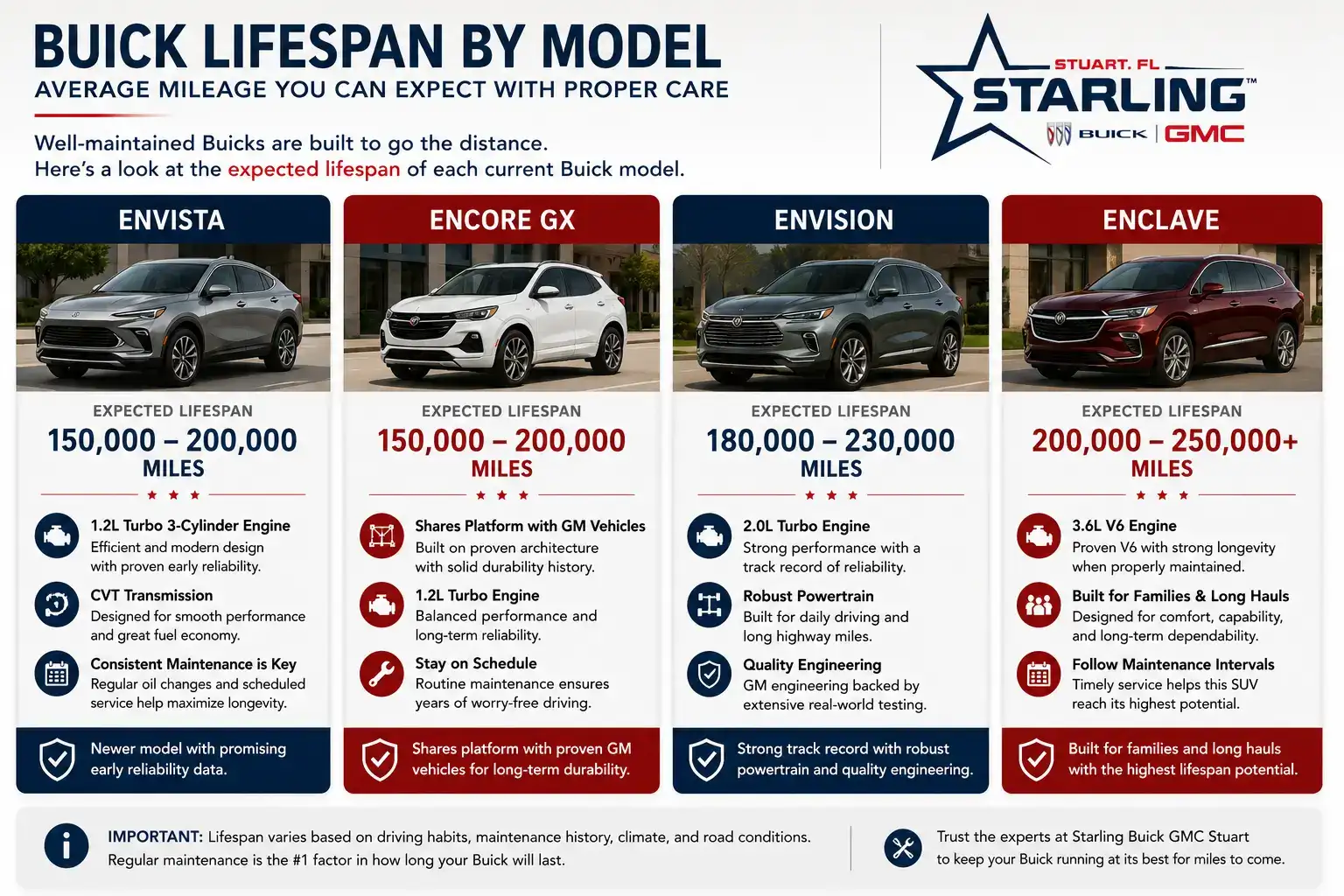
The short version: well-maintained Buicks in the current lineup reach 150,000 to 250,000 miles. The longer version involves understanding which model’s platform and powertrain determine the trajectory, how Florida’s climate affects the calculation, and what maintenance habits separate the Buicks that reach 200,000 from the ones that don’t make it to 120,000.
Quick Answer: The Average Lifespan of a Modern Buick
Modern Buick vehicles, specifically the current-generation lineup of Envista, Encore GX, Envision, and Enclave, are built on GM platforms shared with Chevrolet and GMC vehicles that have established long-term durability records. The Enclave shares its platform with the Chevrolet Traverse. The Envision uses GM’s compact crossover architecture. The Encore GX shares its platform with the Chevrolet Trailblazer. Platform sharing means shared engineering investment and shared durability data from higher-volume nameplate siblings.
The result is a Buick crossover lineup whose longevity potential is not fundamentally different from the Chevrolet and GMC vehicles built on the same bones, which is genuinely good news. The Chevrolet Traverse has documented 200,000-mile examples with regular maintenance. The GMC Terrain, which shares architecture with the Encore GX’s Korean-built platform cousin, shows similar longevity data. Buick’s refinement elements, QuietTuning, premium interior materials, suspension tuning, add cost but do not subtract durability.
150,000–250,000 Miles Depending on Model and Care
The honest lifespan range for current-generation Buicks is 150,000 to 250,000 miles, with the actual number for any individual vehicle determined by three factors: which model and generation it is, how disciplined the maintenance history has been, and whether any model-year-specific issues have been addressed proactively. The lower end of that range, 150,000 to 180,000 miles, reflects vehicles with inconsistent maintenance, significant deferred service, or model-year-specific issues that were not caught and corrected. The upper end, 220,000 to 250,000 miles, reflects vehicles with documented service histories, proactive maintenance, and owners who address issues early. A Buick owner who follows the maintenance schedule, uses quality fluids, and addresses warning signs promptly has a reasonable expectation of reaching 200,000 miles. An owner who treats maintenance as optional has a different trajectory.
Where Buick Ranks Against Toyota, Honda, and Lexus for Longevity
This is where honesty matters more than defensiveness. Toyota and Honda have built longevity reputations over decades that the data supports. The Camry, Accord, CR-V, and RAV4 appear more frequently in 200,000-mile examples in the broader used vehicle market than comparable domestic vehicles, and Consumer Reports’ long-term reliability surveys consistently place Toyota brands near the top of the domestic market reliability rankings, with Buick typically holding the highest domestic brand position but below Toyota and Honda overall. Lexus, Toyota’s luxury brand, has the strongest longevity data of any luxury brand.
The comparison in concrete terms: a 2019 Toyota RAV4 with 60,000 miles has a somewhat stronger statistical probability of reaching 200,000 trouble-free miles than a 2019 Buick Envision with 60,000 miles. That is an honest statement of the data. It is also not the complete picture. Is Buick a luxury car? The brand’s interior quality, technology content, QuietTuning refinement, and price-versus-content value are genuine advantages that the RAV4 does not offer at the same price point. Buyers who prioritize maximum long-term reliability above all other factors should know that a Toyota or Honda alternative has a stronger track record. Buyers who value the premium daily experience Buick provides alongside competitive long-term durability will find the current Buick lineup a legitimate and well-supported choice.
How Long Does a Buick Envista Last?
The Buick Envista is the newest model in the Buick lineup, introduced for the 2024 model year as the most accessible Buick at its sub-$30,000 starting price. Its newness is both its limitation and its opportunity in the longevity conversation: there is not yet the depth of high-mileage owner data that exists for the Envision or Enclave, because the oldest Envistas have only been on the road for approximately two years. What is available is early owner data, platform analysis, and the engineering heritage of the components it shares.
The Envista’s platform is shared with the Chevrolet Trax and similar Korean-built GM models. Its 1.2L turbocharged three-cylinder is a newer powertrain architecture without the established mileage record that older GM four-cylinder engines carry. Early owner data, from the initial 2024 model year production, has not surfaced the kind of systematic failure patterns that emerge in first-year vehicles that have significant platform-level issues.
Expected Lifespan of the 1.2L Turbo 3-Cylinder Engine
The 1.2L LBP turbocharged three-cylinder produces 137 horsepower and is mated to a continuously variable transmission. Three-cylinder turbocharged engines as a category have a less established long-term track record than the four-cylinder engines they often replace, simply because they represent a newer generation of downsized forced-induction powertrains that have not yet produced significant populations of 200,000-mile examples. The CVT transmission also has a mixed long-term reputation in the broader automotive market, CVTs are fuel-efficient but require specific fluid maintenance that, when deferred, significantly shortens transmission life. For the Envista’s 1.2L and CVT combination: changing the CVT fluid at 60,000 miles rather than treating it as a lifetime fill is the single most important extended-service decision an Envista owner can make. The engine itself, with appropriate oil change frequency, should reach 150,000 miles comfortably based on comparable GM small-displacement turbocharged engines. Whether 200,000-mile examples emerge regularly will be clearer in five to seven years as the earliest Envistas mature in service.
What Early Owner Data Suggests (Envista Launched in 2024)
Early owner reports from 2024 and 2025 Buick Envistas are generally positive at the mileage levels where early data exists, 20,000 to 45,000 miles for the earliest production units. No systematic powertrain complaints have emerged in NHTSA data at volumes suggesting platform-level issues. The most commonly mentioned concerns in owner forums are infotainment software responsiveness and minor interior fit-and-finish observations, the category of first-year concerns that tend to be resolved through software updates rather than indicating durability problems. The absence of serious early mechanical complaints is a positive signal for long-term outlook. The absence of 150,000-mile examples to point to is simply a function of the model’s age, not a reflection of what those examples will look like when they exist. Owners considering an Envista for long-term ownership are making a reasonable bet on a new platform without the benefit of the track record that older Buick models carry.
How Long Does a Buick Encore GX Last?
The Buick Encore GX launched for the 2020 model year on a platform shared with the Chevrolet Trailblazer and Korean-built GM crossovers. Its 1.2L and 1.3L turbocharged three-cylinder engines are newer powertrains with developing mileage histories, but its early-generation reliability data is among the strongest in the current Buick lineup.
The Encore GX has consistently earned above-average predicted reliability ratings from Consumer Reports, which is particularly notable for a vehicle that shares its platform with a non-luxury brand sibling (the Trailblazer). J.D. Power initial quality surveys have rated the Encore GX competitively within the premium small SUV segment. Both data points are early-ownership indicators that do not guarantee long-term durability, but they suggest a vehicle that is starting from a solid quality foundation rather than dealing with early-ownership fire-fighting.
Real-World Mileage Reports
The oldest Encore GX vehicles, from the 2020 model year, are now approaching 80,000 to 100,000 miles in the hands of early adopters who drive high annual mileage. Owner reports at this mileage range are generally positive, no major powertrain failures have emerged as pattern concerns at current mileage levels. The 1.3L turbocharged engine on the upper trims, which produces 155 horsepower, appears to handle the Encore GX’s weight and typical use patterns without the thermal stress concerns that more aggressive applications of similar small displacement engines can produce. The CVT pairing on FWD configurations requires the same fluid service attention noted for the Envista, the CVT is the component most likely to define long-term reliability if its fluid is not serviced.
Known Longevity Concerns to Watch
The Encore GX’s primary known concern at higher mileage involves the turbocharged engine’s sensitivity to oil quality and change frequency. Small displacement turbocharged engines generate high heat-per-liter values, and the turbocharger’s bearings are the components most vulnerable to degraded oil. The Florida-specific recommendation for Encore GX owners mirrors the guidance for any turbocharged Buick: use a quality full-synthetic oil, change it at 5,000 miles rather than the maximum Oil Life Monitor interval, and allow the engine to idle for approximately one minute after an aggressive run before shutting down, a brief period that allows the turbocharger bearings to cool with oil flow before the oil pump stops. For a full breakdown of AWD availability and costs, see our Buick Encore GX AWD guide. These habits, consistently applied, address the primary vulnerability of the Encore GX’s powertrain and support the 150,000-plus-mile lifespan that the platform’s engineering otherwise supports.
How Long Does a Buick Envision Last?
The Buick Envision has the most established longevity track record of any current Buick model, having been sold in the US market since 2016 and now producing genuine 150,000-mile examples that provide real durability data rather than projections. The first generation (2016-2020) and second generation (2021 onward) are different enough vehicles, different platform, different engines, different transmission, that they deserve separate treatment.
The Envision’s well-maintained examples reaching 200,000 miles is a documented pattern rather than a promise. J.D. Power has rated the Envision above the segment average in long-term dependability surveys, and Consumer Reports’ predicted reliability score for the second-generation Envision is above average, a meaningful endorsement given Consumer Reports’ methodology. For a deep dive on the driving experience and features, our Buick Envision review covers how it compares in day-to-day ownership. The caveats are real: the first-generation Envision had documented early years with elevated complaint volumes, and the model-year-specific guidance in the Problems by Year article provides the specific navigation for used buyers.
1st-Gen (2016–2020) vs. 2nd-Gen (2021+) Lifespan Differences
The first-generation Envision (2016-2020) was built in China and used a 2.0L turbocharged four-cylinder paired with a 6-speed automatic. The second generation (2021+) introduced a new 2.0L turbocharged four-cylinder producing 228 horsepower paired with a 9-speed automatic. The second generation is a meaningfully different vehicle in terms of powertrain refinement, transmission smoothness, and electronic architecture. The first generation’s documented concerns, particularly in the 2016-2017 years, involved brake system issues and transmission quality complaints that reduced long-term confidence in early examples. The second generation’s cleaner NHTSA complaint record and improved transmission suggest a vehicle with better long-term potential than the early first-gen examples. For used buyers: the second-generation Envision (2021+) has a stronger starting platform for long-term ownership than the early first-generation examples.
The 200,000-Mile Envision Is Common With Regular Service
The 2019-2020 first-generation Envision and the 2022-2024 second-generation Envision both support 200,000-mile expectations under regular maintenance. The 2019-2020 examples specifically benefited from the mid-cycle refresh that addressed the transmission quality concerns of the earlier cars and produced the clearest quality improvement in the first generation’s history. Second-generation Envision owners who maintain fluid service intervals, engine oil, transmission fluid at 60,000 to 80,000 miles, coolant flush at 5 years, are making realistic investments toward a 200,000-mile outcome. The Envision’s platform sharing with other GM products means parts availability and service familiarity support ownership well past the 150,000-mile mark without the supply chain concerns that affect some imported vehicles.
How Long Does a Buick Enclave Last?
The Buick Enclave has been in continuous production since 2008, and the oldest examples from the first generation now have 15-plus years of real-world data behind them. That data is unambiguous: the Enclave is Buick’s most proven longevity platform, with documented examples reaching 200,000 miles routinely in the second generation and with some first-generation trucks in the 230,000 to 250,000-mile range under meticulous maintenance. At Starling Buick GMC Stuart, the Enclave is consistently the Buick model that generates the most ‘coming back for a second one’ customer stories, buyers who put 180,000 miles on an Enclave and come in for another specifically because of their first one’s longevity.
The Enclave’s track record is the strongest argument for the Buick brand’s long-term viability as a used vehicle purchase. A well-maintained 2020 Enclave with 100,000 miles on it is a vehicle with significant life ahead of it. A 2018 Enclave with 120,000 documented miles at its service history represents a strong used value proposition specifically because of the longevity data behind the platform.
Enclave’s 200,000–250,000-Mile Track Record
Consumer Reports’ long-term reliability data on the 2018+ Enclave places it above average for the three-row crossover segment in predicted reliability, a position that is reflected in the real-world ownership reports from Enclave owners in the 150,000 to 200,000-mile range. The 2025 Buick Enclave, with its new 2.5L turbocharged four-cylinder replacing the 3.6L V6, is the newest platform whose long-term track record is still developing. The second-generation Enclave (2018-2024) is the one with the established data. For buyers evaluating an Enclave as a used purchase or a new purchase with long-term retention in mind, the 2018+ generation represents the clearest confidence interval.
Why the 2018+ Enclave Is More Durable Than Earlier Years
The first-generation Enclave (2008-2017) used the GM Lambda platform with a 3.6L V6, and while many first-generation examples have reached high mileage, the generation carried documented timing chain concerns that emerged on higher-mileage examples, along with oil consumption concerns on some 3.6L engines at elevated mileage. The second generation (2018-2024) was completely redesigned on the C1XX platform with revised engine architecture that addressed the timing chain and oil consumption concerns of the first generation. Unlike the Buick Enclave vs Chevy Traverse comparison where both share the same C1XX bones, the Enclave’s QuietTuning and suspension refinements make it the more livable long-term ownership proposition. The new 2018 Enclave’s reliability record has been consistently cleaner than the first generation at equivalent mileage points. The C1XX platform’s suspension geometry, electronic architecture, and engine management improvements translate to a vehicle that ages more gracefully than its predecessor, fewer repair visits per mile at 80,000 to 150,000 miles compared to first-generation examples at the same mileage. For used buyers: the 2018 model year represents a clean break point. First-generation examples require more due diligence; 2018+ examples carry a stronger platform foundation.
What Actually Determines How Long Your Buick Lasts
Platform and model-year selection determine the ceiling of your Buick’s potential lifespan. What you do as an owner determines whether the vehicle reaches that ceiling or falls short of it by 50,000 to 100,000 miles. The three factors below account for the majority of the variance between Buicks that reach 200,000 miles and those that don’t.
These are not hypothetical considerations. They are the specific patterns we observe in Buick maintenance histories at Starling Buick GMC Stuart, the behaviors that correlate with long-lived vehicles versus early failures.
Maintenance Schedule Compliance (The #1 Factor)
The single most predictive variable for Buick longevity is maintenance schedule compliance, specifically, oil change frequency and quality, transmission fluid service, coolant flush timing, and brake fluid condition. Buick’s maintenance schedules are designed conservatively, and the national intervals they specify are not calibrated for Florida’s specific climate demands. In Stuart’s heat and humidity, oil degrades faster, coolant chemistry breaks down more quickly, and transmission fluid sees higher operating temperatures. The maintenance interval adjustments appropriate for Treasure Coast Buick ownership: oil changes at 5,000 miles rather than the Oil Life Monitor’s sometimes-extended interval; transmission fluid service at 60,000 to 80,000 miles regardless of ‘lifetime fill’ designations; coolant flush at 5 years rather than deferring; brake fluid replacement every 2 to 3 years given Florida’s humidity. Owners who follow these intervals consistently are doing the most important thing they can for longevity. Owners who defer service are not saving money, they are converting maintenance costs into repair costs at a significantly unfavorable exchange rate.
Driving Style: Highway Miles vs. Stop-and-Go
A Buick with 100,000 miles that were accumulated primarily on the Florida Turnpike and I-95 is a different vehicle than a Buick with 100,000 miles from daily stop-and-go driving in Martin County traffic. Highway miles are easier on the drivetrain, engines operate in their efficient temperature range, transmissions hold gears without constant cycling, brakes experience less thermal stress, and the overall wear rate per mile is lower. Stop-and-go miles generate more cold starts, more frequent gear changes, more brake applications, and sustained low-speed operation that accumulates wear more rapidly. A Buick used for a mix of local errands and occasional highway trips sits in a middle position. The specific impact for Stuart Buick owners: if your Buick does primarily short local trips, the service interval adjustments described above are especially important because short-trip driving specifically degrades oil and accumulates combustion byproducts faster than highway use.
Original vs. Second Owner Effect
Vehicles that have been with their original owner from new and maintained consistently throughout the ownership period consistently outperform the same vehicle that has changed hands multiple times. The reason is not that second owners are necessarily worse at maintenance, it is that continuity of care creates a complete, verifiable history that allows each service to build on the last. A technician who knows a Buick’s full service history can spot when a fluid is approaching the end of its service interval, when a component is nearing replacement, or when a developing symptom was first noted. A vehicle that has changed hands twice in 10 years often has documentation gaps that leave mechanics, and owners, guessing about what has and has not been done. For used Buick buyers specifically: verifiable, complete service records are more valuable than low odometer readings when evaluating the vehicle’s long-term outlook. A Buick with 95,000 documented miles is a more confident purchase than one with 75,000 miles and no paperwork.
How Florida Climate Affects Buick Lifespan
Every Buick lifespan consideration described above is amplified by Stuart’s specific climate, and in ways that are different from what most national guidance accounts for. The combination of sustained heat, high humidity, salt air from the Treasure Coast, and the short-trip driving pattern common in Martin County’s retirement communities creates a set of accelerants that work against vehicle longevity.
The good news: every one of these accelerants is manageable. They require specific adjustments to maintenance intervals and habits, but they do not make long-lived Buick ownership impossible in Florida. They make it dependent on the correct habits rather than the national-average habits that suffice in cooler, drier climates.
Heat, Humidity, and Salt-Air Corrosion on Coastal Cars
Heat at the coastal Treasure Coast level, sustained ambient temperatures of 90 to 95 degrees from June through September, with high humidity year-round, degrades oil chemistry approximately 20 percent faster than the 65-degree ambient that national oil change intervals assume. Coolant breakdown is similarly accelerated. Battery life is shortened by approximately one-third relative to northern markets. For Buick crossovers specifically, the HVAC system’s condenser is front-mounted and directly exposed to the corrosive salt air that flows through every mile driven near the Indian River Lagoon and the Atlantic coast. Annual condenser inspection and proactive cabin air filter replacement, at 12,000-mile intervals rather than the 15,000 to 20,000-mile intervals appropriate for non-coastal markets, are the most effective maintenance adjustments for Treasure Coast Buick owners. Rust protection on brake components, wheel arches, and underbody surfaces is also meaningfully more important within five miles of the coast than it is for Stuart residents in inland areas.
Why Short-Trip Driving Wears Buicks Faster Than Highway Miles
Stuart’s geography creates a lot of short-trip driving: the distance from any residential area to grocery stores, medical appointments, and restaurants is typically 3 to 10 miles, and many Treasure Coast Buick owners, particularly in the retirement community demographic that represents a significant portion of our local customer base, use their Buick exclusively for these short local trips without regular highway use. Short-trip driving is the engine’s least favorable operating condition: cold starts generate more internal wear than warm starts, engines that never fully heat-cycle accumulate condensation in the crankcase, and the oil life monitor’s interval calculation is based on average operating patterns that include more highway miles than the all-local-trips pattern generates. The practical fix: take your Buick on a 20 to 30-minute highway run on US-1 or I-95 once a week. This allows the engine to reach full operating temperature, drives off accumulated moisture, and ensures the oil change interval you are using is based on realistic engine conditions rather than artificially low wear indicators.
6 Habits That Push a Buick Past 200,000 Miles
The Buick owners at 200,000 miles who come back for another one share a consistent set of habits. None of these habits are exotic or expensive. They are the specific behaviors that, compounded over 200,000 miles, determine whether a vehicle reaches that milestone or falls short.
First: oil changes at 5,000-mile intervals using full-synthetic oil, no exceptions, no deferrals, no Oil Life Monitor extensions in Florida’s heat. Second: transmission fluid service at 60,000 to 80,000 miles regardless of what the manual says about lifetime fill. Third: coolant flush at 5-year intervals without exception. Fourth: cabin air filter replacement every 12,000 miles given Treasure Coast air quality. Fifth: addressing any dashboard warning light within the same week it appears, not deferring to the next available Saturday. Sixth: a comprehensive inspection at 100,000 miles from a GM-certified technician who can assess the vehicle’s systems proactively rather than reactively. Each of these habits taken alone is useful. All six together are what separate the 200,000-mile Buick from the 130,000-mile Buick.
Signs Your Buick Is Approaching the End of Its Life
Buick vehicles that are nearing the end of their service life communicate it through specific, identifiable patterns. Recognizing these patterns early allows owners to make the replace-or-repair-or-trade decision with full information rather than being forced into an unplanned vehicle purchase by a terminal failure. The patterns to watch: progressively increasing repair frequency, where the vehicle is in for unscheduled repairs three or more times in a 12-month period; oil consumption that requires adding oil between changes, indicating ring seal wear; transmission behavior changes including slipping, delayed engagement, or harsh shifts that have progressed despite fluid service; coolant system concerns that recur within a year of the previous repair; and structural or body concerns including rust, seal failure, or suspension component degradation that collectively suggest the vehicle is entering a cycle where repair costs will consistently exceed the vehicle’s market value. None of these individually is a terminal verdict. Multiple of them presenting simultaneously, on a high-mileage vehicle, are the signal that the long-term ownership calculation has shifted.
Frequently Asked Questions
These are the longevity questions that come up most frequently from Buick buyers and owners at Starling Buick GMC Stuart, answered based on our service history and the available reliability data.
Which Buick model lasts the longest?
The Enclave, specifically the 2018+ second-generation Enclave, has the strongest documented long-term track record of the current Buick lineup. The 200,000-mile Enclave is a documented reality with real examples in the market. The Envision has a strong track record in its second generation (2021+). The Encore GX and Envista are newer models whose long-term data is still developing. For a full comparison across the lineup, see our guide to Buick SUV models by lifespan and reliability.
Is a Buick with 100,000 miles still a good buy?
A Buick with 100,000 documented miles and a verifiable service history is comfortably in the middle of its potential service life, not near the end. The key is verifiable documentation. A clean Carfax and a history of dealer or certified mechanic service records at appropriate intervals are what make 100,000 miles on a Buick a starting point rather than a concern. Our CPO Buick inventory at Starling Buick GMC Stuart is specifically vetted to provide this confidence for used buyers.
How does Buick reliability compare to Toyota or Honda?
Toyota and Honda have stronger long-term reliability track records than Buick based on Consumer Reports data and the broader used vehicle market’s 200,000-mile example frequency. This is honest and worth knowing. Buick holds the top position among domestic American brands in Consumer Reports predicted reliability, a genuine achievement relative to other US nameplate options. The comparison to Toyota specifically should be understood as Buick being competitive and improving, while Toyota’s advantage in the longevity data reflects decades of accumulated track record.
Do Buicks have expensive repair costs?
RepairPal estimates Buick’s average annual maintenance cost at approximately $608, which is competitive with the luxury segment and below the industry average for comparable premium vehicles. The Envision specifically is estimated at approximately $8,521 over 10 years in total maintenance cost, $896 below the SUV segment average. Buick’s repair costs benefit from platform sharing with Chevrolet and GMC, which means parts availability and technician familiarity are broader than for standalone luxury brands. This cost advantage is reinforced by Buick’s factory warranty coverage, which provides 3-year/36,000-mile bumper-to-bumper and 5-year/60,000-mile powertrain protection on new vehicles.
At what mileage do Buicks start having problems?
There is no universal mileage threshold at which Buicks ‘start having problems.’ Vehicles that are maintained correctly tend not to have major unscheduled issues at any mileage until the natural end of wear cycles on high-cycle components like the transmission, wheel bearings, and suspension components. The mileage at which a poorly maintained Buick encounters its first major unscheduled repair is typically 60,000 to 90,000 miles, the point at which deferred fluid service, ignored warning lights, and accumulated small issues converge into an expensive repair event.
Find a Long-Lasting Buick at Starling Buick GMC Stuart
At Starling Buick GMC in Stuart, our Certified Pre-Owned Buick inventory represents the standard for used Buick confidence, vehicles that have been through a multi-point inspection, have verified service histories, and carry GM’s CPO warranty coverage that protects your long-term ownership investment. If you are looking for a Buick that will reach 200,000 miles, the CPO route is the one that gives you the documented foundation to be confident about that outcome.
For new Buick buyers who are purchasing with long-term retention in mind: our service team can walk you through the Florida-specific maintenance schedule adjustments that matter for our climate and set you up for the service intervals that produce the long-lived Buick outcome. Schedule a service appointment or consultation at 2445 SE Federal Hwy in Stuart.
Conclusion
The honest answer to ‘how long does a Buick last’ is 150,000 to 250,000 miles, with the actual number determined primarily by maintenance discipline and secondarily by model and generation selection. The 2018+ Enclave has the strongest long-term track record of the current lineup. The second-generation Envision (2021+) is on a strong trajectory. The Encore GX and Envista are newer models with developing but encouraging early data. The Envista’s 1.2L three-cylinder is the powertrain with the least established long-term track record in the current lineup. Against Toyota and Honda, Buick is competitive but trailing, an honest position that a buyer who values the Buick experience should weigh alongside the durability data rather than dismissing either the comparison or the conclusion. At Starling Buick GMC Stuart, we back the vehicles we sell with the service infrastructure to help them reach their potential lifespan.
0 comment(s) so far on How Long Does a Buick Last? Lifespan & Reliability by Model